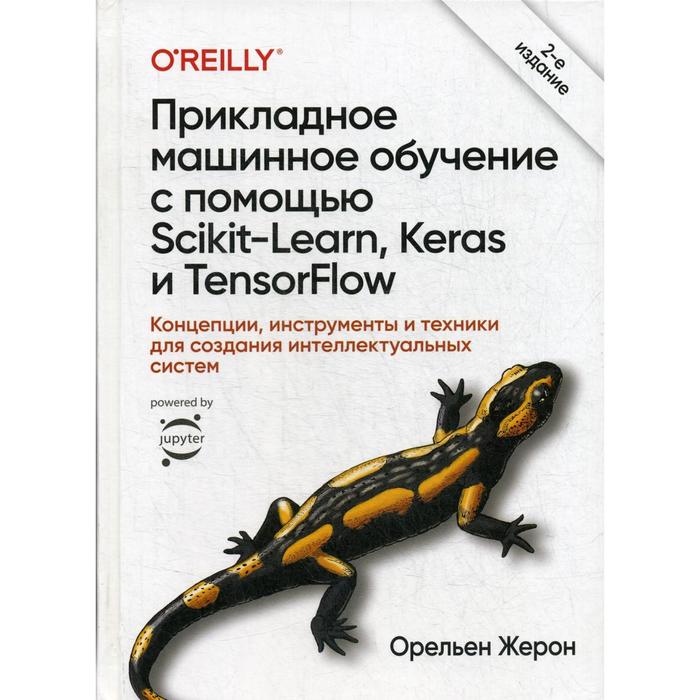
Applied machine learning using Scikit-Learn, Keras and Tensorflow 2: concepts, tools and techniques for creating intelligence systems. 2nd edition
Outstanding resource for studying machine learning. You will find clear and intuitive explanations here, as well as an abundance of practical tips.
Francois Sholle, author of the Keras library, author of Deep Learning with Python
This book is a wonderful introduction to theory and the theory and practice of solving problems using neural networks; I recommend it to everyone who is interested in mastering practical machine learning.
Pete Warden, the head of the mobile development team Tensorflow
thanks to a series of outstanding achievements, deep education significantly strengthened the entire area of machine learning. Nowadays, even programmers who know almost nothing about this technology can use simple and effective tools for implementing programs that are able to learn on data. The new edition of the Bestseller book, based on specific examples, a minimum of theory and ready-made Python Framwon production level, will help you get an intuitive idea of concepts and tools designed to build intellectual systems.
You will master a wide range of methods You can quickly engage in practice. Given the presence in each chapter of exercises designed to consolidate what you have learned, only experience in programming is needed to start work. All code is available on GitHub. It was updated taking into account Tensorflow 2 and the latest version of Scikit-LEARN.
Features of the book
- Study the basics of machine learning on the through project using Scikit-Learn and Pandas
- Build and train neural networks with numerous architectures for classification and regression using Tensorflow 2
- Read the identification of objects, semantic segmentation, mechanisms of attention, linguistic models that generate adversarial networks and many others
- Explore the Keras API - the official high -level API -interface for Tensorflow 2
- start the production of Tensorflow using the Tensorflow DATA, TF TRANSFORM and TF Serving
- strategies. Deploy models on the AI Platform platform Google Cloud infrastructure or on mobile devices
- Use teaching methods without a teacher, such as lowering dimension, clustering and detecting anomalies
- Create autonomous learning agents using training with training with reinforcement, including using the TF-Agents
- library, the book is discussed in a separate message on the blog of Viktor Shtonda
| Characteristics | |
| A country | Russia |
| Kit | No |
| Number of pages | 1040 |
| The year of publishing | 2020 |
| Type of cover | Hard cover |
There are no reviews for this product.