
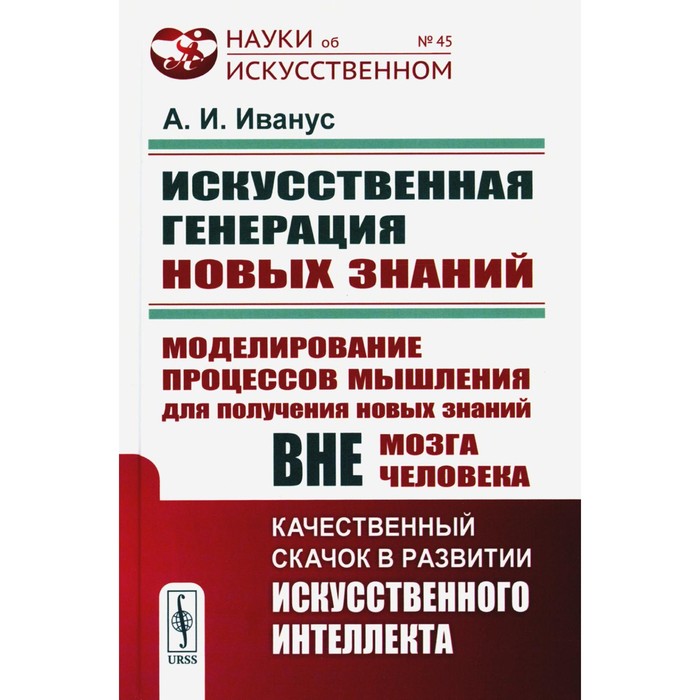
Artificial generation of new knowledge. Modeling thinking processes to obtain new knowledge outside the human brain. Ivanus A.I.
The human brain cannot think according to the rules of mathematics, he thinks according to the rules that evolution has determined him. Nevertheless, it was the “non -dumatic” brain that created mathematics. For what?
the mathematical language guarantees the maximum intuitive truth of the derived conclusions, which, in principle, should not have alternatives and contradictions due to the corresponding choice of the system with axioms, proof of theorems and other things.
as opposed to the mathematical Our natural verbal language contains alternatives to almost any conclusion. The ontology of knowledge in a verbal language is a kind of informational “broth”, consisting of alternative and contradictory, but true data on the subject area. Of the two alternative statements: the glass is half empty and half full - both true. From this verbal “broth”, the brain forms stable structures in the form of semantic nuclei of the truth of knowledge. These semantic nuclei are semantic "units" of thinking. It is precisely such structures that the brain uses in its implementation of the “non -dumatic” process of generating new knowledge, realizing the principle of “truth from uncertainty”, as well as “the order of their chaos”. This approach was investigated and proposed as a working hypothesis about the possibility of generating new knowledge outside the human brain.
The manual is designed for bachelors, masters, graduate students and scientists studying the problems of generating new knowledge, cognitive methods, artificial intelligence and related With them questions and tasks.
| Characteristics | |
| A country | Russia |
| Author | Ivanus Alexander Ivanovich |
| Number of pages | 200 |
| The year of publishing | 2022 |
| Type of cover | Hard cover |
There are no reviews for this product.