
Believe me. I love you. Fillosa I.



There are sons and daughters who call mom and dads every day - and there are those who never call them. There are those who build a house closer to the parent - and there are those who try to settle as far as possible from them, and prefer not to see them at all. There are children who are difficult to make decisions without dad, mothers, and others - for whom concessions to family obligations are permissible only for Christmas, weddings or funerals. Everyone has different relationships. And almost always all relations have a rich, and sometimes difficult story. We are associated with our parents a common past, such a load behind him; It is difficult to observe the distance. Both from the parent and an adult child, any position is possible here, except the simplest. Most people are ready to come to terms with what is, they are sure that nothing can be changed anyway. Meetings are exhausted by the well -known rules of conduct, which no one wants to question.
Relations can be cold and alien, falsely sincere. And they can be stormy or silent, superficial or vice versa. They can - painful and tense or neutral and inexpressive. Rarely they are balanced, healthy and harmonious. Relations "Parents/Children" look natural. But if you think about it well - they require phenomenal adaptation abilities! We are not the same at two months, at fifteen, at thirty or seventy. Throughout our lives, we have various needs. Since children grow up, and parents are aging, relationships naturally unbalanced and look for balance again. They are obliged to constantly change in order to respect the evolution of both parties. You can not make a relatively simple scheme without risking the deafly close in it one or the other side. How to be? How to find harmony in a relationship? All past wounds must be discussed and recognized, misunderstandings are explained, anger must be expressed and welcomed to establish a connection. Then reconciliation is born out of mutual sympathy. Why agree to a superficial relationship when it is possible, and this is possible in most cases, (repeatedly) to create relations of proximity and complicity?
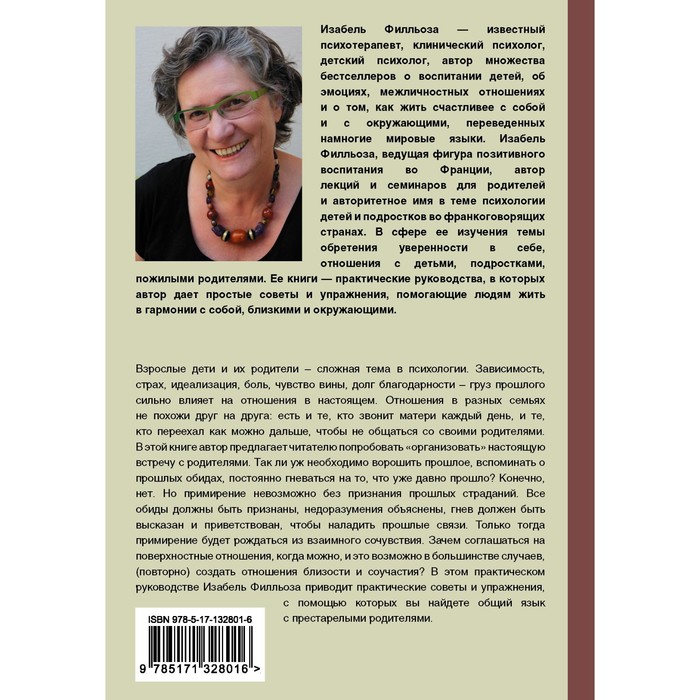
The book of the famous French psychologist Isabelle Fillolia will give indispensable advice to adults and their parents regarding their relationships and will help to find harmony in relationships.
From this book you will select the right solution to the following problems for yourself:
Exceeding the power by parents, what to do?
Resentment, condemnation and humiliation/"causeless" wounds, what to do?
prohibitions and instructions, how to respond?
Alcoholism, mental instability and anxious parents, what to do?
What to do when the needs are ignored?
The cargo of the past/ Feeling of guilt among mothers, how to overcome?
Does the mother have the right not to love her child?
The prolonged stress leads to a disease, what to do?
How to move from anger aggressive to constructive anger?
Refuse or fulfill gratitude?
"Parents are not judged, they are forgiven!" Is it true?
It will kill him! / I'm afraid to die! How to proceed?
Turn away from parents/ Throwing your parents, what to do?
How to love a child in yourself?
How to free yourself from hatred?
If your parents are no longer in the world, and their shadow still haunts you?
| Characteristics | |
| A country | Russia |
| Age | From 16 years old |
| Author | Fillosa Isabelle |
| Kit | No |
| Number of pages | 320 |
| The year of publishing | 2022 |
| Type of cover | Hard cover |
| View | Psychology of relations |
There are no reviews for this product.