
Cloves "Princess of Turkish", 0.2 g flowers
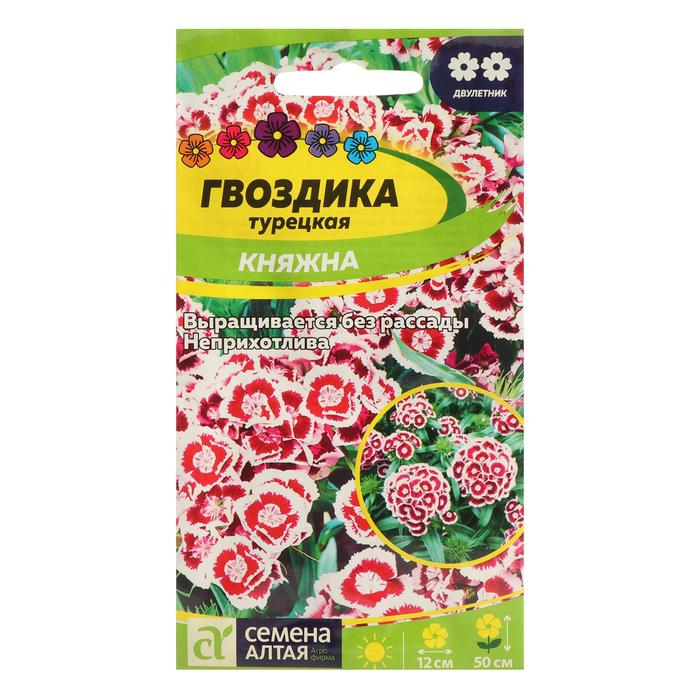


An elegant garden plant grown as a biennial. The bushes are branched, up to 50 cm high. The leaves are linear-lanceolate green. By the end of the first year of cultivation, a rosette of basal leaves is formed. Numerous bright red and white fragrant flowers are collected in shield-shaped inflorescences up to 8-12 cm in the diameter. The abundant flowering of Turkish cloves in the second year after landing, from late June to July, will become a decoration of any flower garden, flower beds, and curb planting. An unpretentious cold -resistant plant prefers sunny areas with light fertile, well -drained soil with a neutral reaction. Sour soils must be neutralized with lime. Sowing seeds is carried out in late May-early June to the raspberry ridges to a depth of 0.5-1 cm. Seedlings in the phase of 2-3 of these leaves are pulled out or dive with an interval of 10 cm. In August, they are transplanted to a permanent place with an interval of 20-30 cm In the first year, the plant forms a rosette of leaves. For the winter, it is advisable to cover young plants with spruce branches. Flowering occurs in the second year and lasts from July to August.
| Characteristics | |
| A country | Russia |
| Agronomic expiration date, years | 5 |
| Ampelous | No |
| Appointment | To create flower beds, flower beds |
| Attitude to light | Scattered light |
| Color | White |
| Curly (vines) | No |
| Features of growing | Open soil |
| Flowering period | Summer |
| In height of the bush | Tall (over 80 cm) |
| In the shape of a bush | Bush |
| Sowing for seedlings | February |
| Sukhotzet | Yes |
| Terry | Yes |
| Variety | Blooming |
| Vegetation | Perennials |
| View | Carnation |
There are no reviews for this product.