
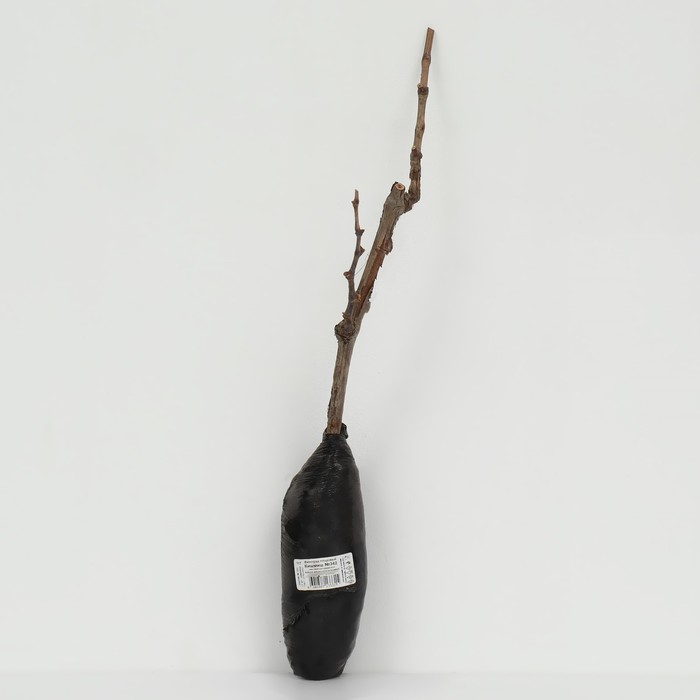
Fruit grapes (bloodless varieties) "Kishmish No. 342", 1 pc, tube, spring 2025
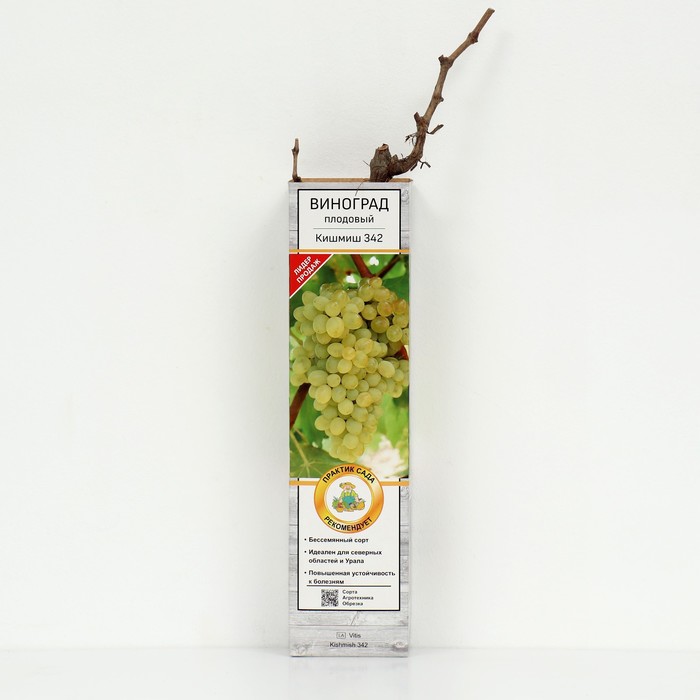


Variety of grapes Kishmish 342 was bred by Hungarian breeders. Parents are a famous station wagon European Vilar Blanc and American Sidlis Pertlet. The variety is known for synonyms of Kishmish Hungarian and GF 342. It meets the needs in stable bloodless varieties.
Berries are small, weighing 2-3 grams. The skin is light, yellow, in the sun it acquires a tan. It is thin and delicate, when food is not felt, and so that the berries are not damaged by Osami, mesh bags are put on the clusters.
There are no bones or rudiments in the berries - according to different sources, this is the second or third class of belessness. The larger the load, the less rudiments, therefore, the quality of the signal thunderstorm conclusions draw prematurely.
The pulp is elastic, the taste has a unambiguously sweet one, from simple to harmonious with a light nutmeg. The form is distinguished by high sugar-pushing, about 19-21%. The clusters are medium and large. The variety loves the accumulation of wood, on adult bushes, a brush is not uncommon.
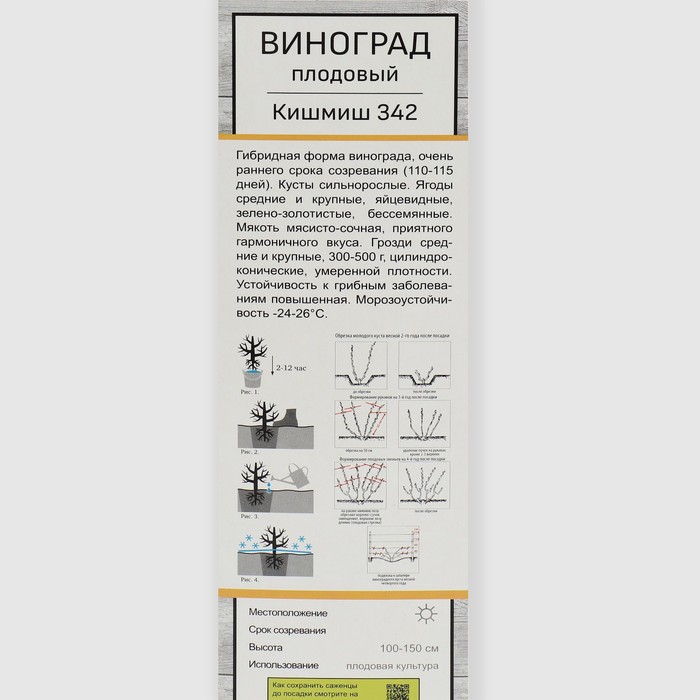
The ripening period is early, 110-115 days pass from the blooming of the kidneys to removable ripeness.
Kishmish 342 is suitable for food in fresh form and for drying raisins. The clusters are capable of staring on the bush (for this they can be twisted). Grapes of this variety are also stored in the refrigerator.
The yield is high, up to 20-25 kg per bush. Fruit stably. On the bushes, it is better not to overexpose the crop, although some gardeners are in no hurry to take it off, they hold it almost until September. The transportability is good. The variety is suitable for baby food.
GF 342 is characterized by a high growth force of Lian. For shelter for the winter, you will have to work, since the vines are quite elastic.
Frost resistance of its different nurseries characterize in different ways: who declares a temperature of -22 ° C, and sometimes up to -26 ° C. The shoots ripen well.
pleases the good resistance of a pick -up 342 to patho of fungal diseases. Some grapes and nurseries consider it high. In many ways, this is due to the early ripening timing - neither Mildu nor the Oidium do not have time to develop. Costs the average number of treatment with fungicides. Sometimes it is also necessary to use insecticides - a leaflet or a spider mite can settle on the bushes.
Cuttings take root well. You can plant this hybrid form of the root, you can - vaccinated. By laying a vineyard, the plants should provide sufficient food area. Pits are made with a depth of 80 centimeters, and with a diameter - at least 70. A layer of drainage is laid on the bottom, then filled with half fertile soil mixed with fertilizers. Usually add a bucket of humus and a can of wood ash, everything is mixed. They plant grapes in warm soil (in the spring) or a month before the onset of frosts (in the fall). The vaccination site is left on the surface.
In the care of the Hungarian Kishmish is quite unpretentious. Pruning is made medium, 6 kidneys, or long - for 10 eyes. In summer, it is necessary to remove stepson and thickening shoots, because the form is prone to growth. It is not overloaded, the average number of brushes to escape is 1.2, so the crop does not require normalization. As in many other Kishmishas, the processing of gibberellin gives positive results: the berries increase in size, the percentage of non -seeded increases.
| Characteristics | |
| A country | Russia |
| Curly (vines) | No |
| Delivery season | Spring |
| Frost resistance | From -29.1 to -35 ° C |
| Temper. restriction not lower ℃ | 0 |
| The root system | Closed |
| Type of packaging | Tube |
| View | Grape |
There are no reviews for this product.