
Gallery of famous artists
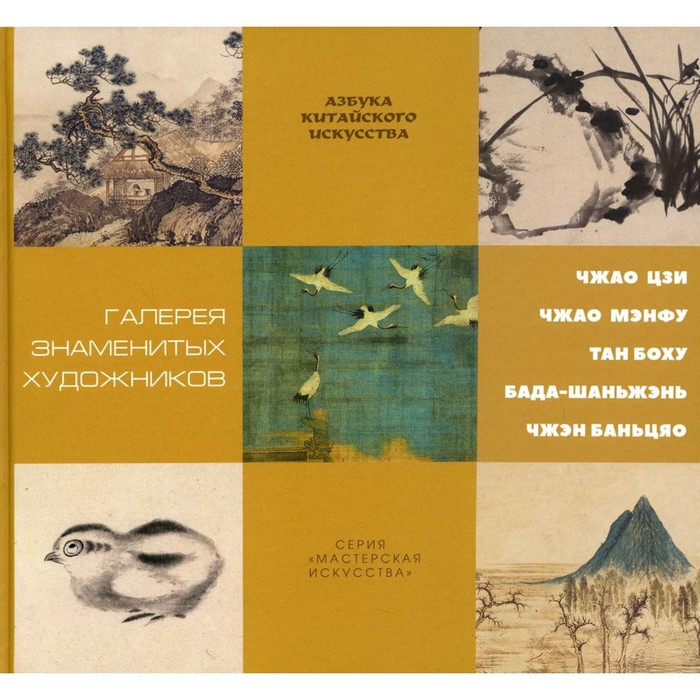
The illustrated edition consists of five parts, the authors of which in a fascinating form tell about the famous Chinese artists of antiquity and the Middle Ages, their picturesque and calligraphic works.The first part is dedicated to Zhao Ji (1082-1135), an outstanding calligrapher, painter, poet who entered Chinese history as Emperor Huii-Zun.Over the past five millennia, China has invited their names a myriad of rulers, princes, nobles and military leaders.Nevertheless, the unique fate of the Sun Emperor Hui-Szun, like a dazzling light, again and again preterminates human eyes.Who is he - an inglorious ruler who led to the death of the North Song dynasty, or a talented artist who left the descendants the richest cultural heritage? The second part tells about the artist, Calligraph, the writer Zhao Manfu (1254-1322), who did in the Yuan era.Almost a thousand years after the death of Zhao Manfu, people still study the history of his life, put forward various assumptions and admire him.All this happens because, being in a very difficult life situation, this amazing person left a huge precious artistic heritage for future generations.The third part is about Tan Boch (Tan Yin, 1470-1523), he was one of the leading painters of the Ming era, possessed extraordinary artistic talents, became famous among his contemporaries as “talent from Jiang.Artists of Chinese traditional painting are often represented by conservative and serious, but in the case of Tan Boch, this is not at all like.Indeed, if you turn the scrolls, look at his paintings and read poetry, you can find in them a much more interesting, more complex and more exciting image of Tan Boch.The fourth part is dedicated to the work of the famous monitor-monk nicknamed Bad Shangen (Zhu yes, 1626-1705).He belonged to an aristocratic family, bore the surname of the emperors of the Ming dynasty, but the tragic events in the country's life forced him to move away from society and take refuge in the monastery.A steep turn of fate brought Zhu yes to the complex and thorny path of a man of art.His life is full of mysteries and oddities, which still do not find an explanation.Even the translation of the nickname of Bada-Sanjen has several versions-“Man from the mountain of Bad”, “Man of the Eight Great Mountains”, “Hermit of Eight Greatness”, as eight directions of the parties are figuratively called in China.Fortunately, the work of Bad Shanzhen, and he was not only an outstanding artist, but also a talented calligraph and poet, helps us step by step to understand his mysterious, extraordinary personality.The fifth part presents the works of a famous writer, artist and calligrapher Zheng Banziao (Zheng Ce, 1693-1765).During the Qing dynasty (1644-1911) the city of Yangzhou in the southeast of China flourished.Rich merchants traveled across the country, have seen a lot, learned a lot, and all as one became passionate collectors of works of art.Eight artists were considered the most original, whose works amazed with a wonderful, original style.Subsequently, they were called "eight eccentrics from Yangzhou".The most colorful and influential in this “eight of eccentrics” was Zheng Banziao, who all his life was written by bamboo, orchids and stones, organically combining painting and calligraphy in his paintings.
| Characteristics | |
| A country | Russia |
| Age | From 6 years |
| Author | The team of authors |
| Editor | Jie Ts. |
| Kit | No |
| Number of pages | 144 |
| The year of publishing | 2021 |
| Type of art | Fine |
| Type of cover | Hard cover |
There are no reviews for this product.