
Occlusion and pathology of occlusion. Color Atlas. Barrett N.V.D., KAPP N.D., Khovat A.P.
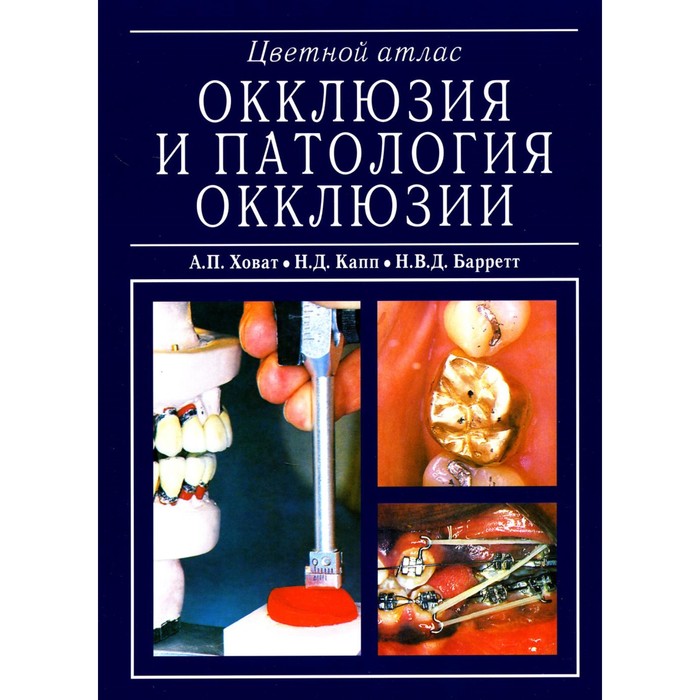
In this Atlas, the principles of diagnosis and treatment of pathology of occlusion in orthodontics, restoration dentistry and when creating removable complete prostheses are illustrated. A multidisciplinary approach is necessary, since the relationship between dentists of different specialties or even one specialty requires the same understanding of the terminology and elements of both static and functional assessment of occlusion.
Many books on issues of occlusion are a list of definitions. The atlas format allowed the authors to use the advantages of text, drawings and clinical slides to ensure maximum clarity.
Some monographs are a catalog of several articulator systems. However, the authors of this Atlas believe that it is much more important to achieve a clear understanding of the movements of the lower jaw from the reader. Only after this is a description of how close the various types of articulators are able to reproduce these movements. A similar approach allows you to provide a reasonable choice of an adequate articulator system.
Particular attention is paid to the use of models installed in the articulator for functional, not static estimates of occlusion.
Treatment aimed at optimizing occlusion can be carried out using either a “conformative” or a “reorganizing” approach. These terms are familiar to most dentists involved in restoration treatment, but are unfamiliar to many orthodists. Conformative treatment involves the preservation of the existing stable interburque position (MBP) and does not lead to a change in the ratio between the posterior contact position (ZKP) and the interbug. The reorganizing approach involves the elimination of the differences between the rear contact position and the interburcular position, and also leads to the creation of a new stable interburque position close to the rear contact position of the lower jaw.
In accordance with the above definitions, the local orthodontic movement of the tooth to the existing MBP is conformative. Correction of a violation of the bite of the II or III class in class I is also conformative in the absence of pre -conducted treatment aimed at eliminating the differences between the WKP and the MBP. In such a situation, orthodontic treatment should not lead to a change in the position of the joint head in the maximum inter -clock position. However, treatment becomes reorganizing when eliminating the existing difference between the ZKP and the MBP.
With complete adenses, the loss of natural teeth and proprioceptive sensitivity from the periodontal ligament requires the use of a reorganizing approach. The rear contact position is the only stable and reproducible ratio of the jaws in which a new MBP can be created.
A similar classification of therapeutic measures has several advantages. She pays attention to the creation of occlusion, correct from a functional, not a static point of view. To achieve this goal, it is recommended to avoid the manufacture of restorations or to the tooths of the positions that impede the movements of the lower jaw or lead to the destabilization of the interburcular position. Such a preventive approach allows you to reduce the likelihood of functional disorders that can develop in the future.
This book for teeth uses the system of the International Federation of Dentists (FDI), since it is it that is the most common in the world. Four quadrants of the oral cavity are indicated by the first of two digits: in the presence of permanent teeth and milk. The second numbers indicate individual teeth, for example, 18, 17, 16, 15, 14, 13, 12, 11 for the constant teeth of the right quadrant of the upper jaw and 61, 62, 63, 64, 65 for the milk quadrant of the upper jaw.
Atlas is intended for students, residents, dentists of general practice, specialists in restoration dentistry, orthodontists and dental technicians. In addition, this atlas is recommended by maxillofacial surgeons conducting orthogonatical interventions.
| Characteristics | |
| A country | Russia |
| Author | The team of authors |
| Number of pages | 235 |
| The year of publishing | 2005 |
| Type of cover | Hard cover |
| View | Specialized medicine |
There are no reviews for this product.