
Organic fertilizer "noble farmer", bone flour, 1 kg
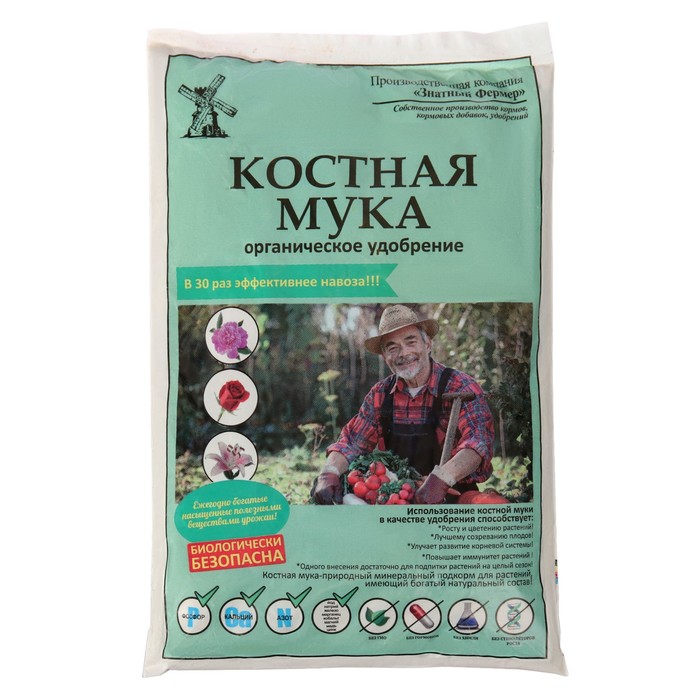
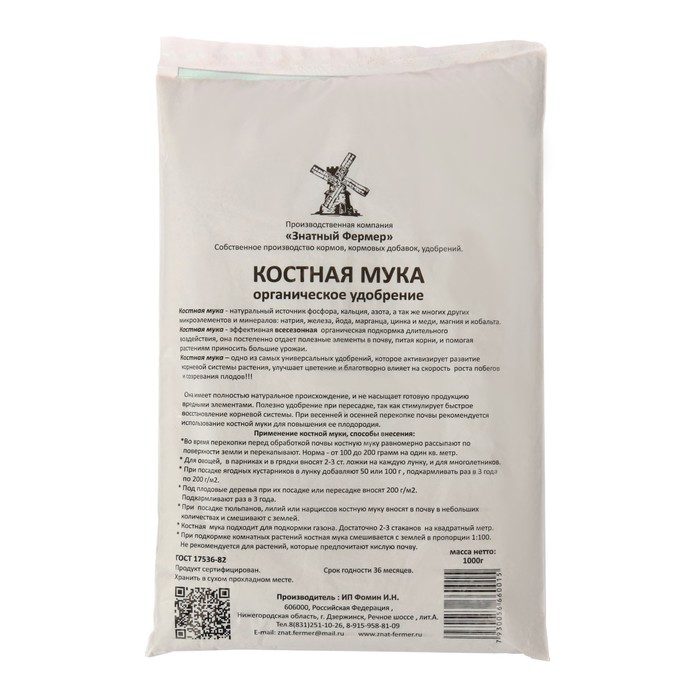


Bone flour is a natural source of phosphorus, calcium, nitrogen, as well as many other trace elements and minerals: sodium, iron, iodine, manganese, zinc and copper, magnesium and cobalt.
Bone flour is an effective all -season organic top dressing of prolonged exposure, it gradually gives useful elements to the soil, nourishing roots, and helping plants bring large yields.
Bone flour is one of the most universal fertilizers that activates the development of the root system of the plant, improves flowering and has a beneficial effect on the growth rate of shoots and ripening of the fruits !!!
It has a completely natural origin, and does not saturate finished products with harmful elements. Fertilizer is useful during transplantation, as it stimulates the rapid restoration of the root system. With spring and autumn soil, the use of bone flour is recommended to increase its fertility. Bone flour-organic fertilizer
Phosfoazotin is another name for this substrate, obtained mainly from the ground bones of the cattle skeleton. Bone/meat-bone flour is a biologically safe source of phosphorus and calcium, as it has an animal origin, and completely decomposes in the soil in 6-8 months, turning into its composition. When applying it, there is no danger of oversaturated the grown products with nitrates and pesticides, as when using mineral and even large doses of organic fertilizers of animal origin (manure and droppings). Due to this property, fertilizer (bone flour) can be applied even two weeks before removing fruits (for example, under tomatoes to significantly improve their taste), which is strictly prohibited for other fertilizers.
In accordance with GOST, it contains in significant quantities such elements as calcium and phosphorus, which makes bone flour indispensable natural fertilizer
This complex is also especially effective because, in addition to phosphorus and calcium, its composition contains biologically active substances (BEV), and many trace elements (magnesium, sodium, iron, copper, zinc, manganese, cobalt, iodine), Which in moderate quantities in the most favorable way affect the growth and development of plants not only in the garden or in the garden, but also at home.
The technology of using bone flour is as follows:
- for fruit trees - 1 time in three years, the norm of introduction - 200g on a sq.m. This is especially useful for trees with a damaged root system, it restores the roots.
- When transplanting berry shrubs-50-70 g in a hole in the spring, and 70-110 g-in the autumn period.
- Bone flour is also needed with spring planting on bulbous plants, such as tulips, daffodils, lilies and lilyniki.
- The production of completely natural composts will not do without flour from cattle. It belongs to those few organic fertilizers that contain a large amount of phosphorus and potassium that lack the plant components that are part of composts.
Bone flour is one of the most universal fertilizers that has a beneficial effect on almost all field, garden and garden crops. It has a completely natural origin, and does not saturate finished products with harmful elements. Bone flour perfectly neutralizes the acidity of the soil. Another plus from making flour from bones-it decomposes within 5-8 months, which makes it fertilizer with a prolonged validity period, which gradually gives useful elements to the soil, nourishing roots, and helping plants bring large yields !!!
The use of bone flour, methods of introduction:
- During digging before processing the soil, bone flour is evenly scattered on the surface of the earth and dug. Norm - from 100 to 200 grams per square meter. meter.
- For vegetables, in greenhouses and in the beds, they introduce 2-3 tbsp. tablespoons for every hole, and for perennials.
- When planting berry shrubs, 50 or 100 g are added to the hole, fed in 3 years 200 g/m2.
- under fruit trees, when planting or transplanting, 200 g/m2 are made. They feed once every 3 years.
- When planting tulips, lilies or daffodils, bone flour is introduced into the soil in small amounts and mixed with the ground.
- Bone flour is suitable for feeding the lawn. 2-3 glasses per square meter are enough.
- When feeding indoor plants, bone flour mixes with the ground in a proportion of 1: 100.
- is not recommended for plants that prefer acidic soil.
| Characteristics | |
| A country | Russia |
| Application area | Universal |
| Complex fertilizers | No |
| Effect | Harvest increase |
| Groups of elements | Macro -appropriation |
| Hazard Class | Grade 3 (moderately dangerous) |
| Origin | Organic (natural) |
| Periods of application | Year -round |
| Preparatory form | Granules |
| View | Fertilizers |
| Weight, g/volume, ml | 1000 |
There are no reviews for this product.