
The art of Japan. Big illustrated encyclopedia
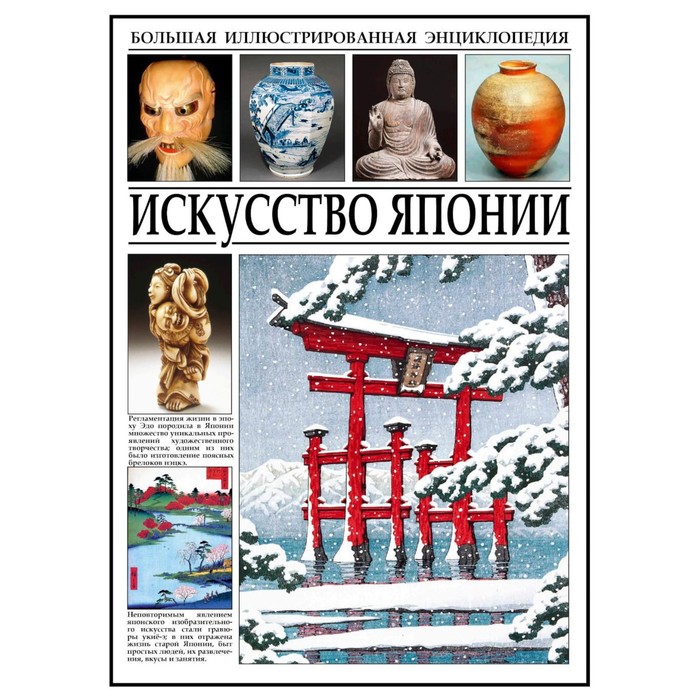
The Japanese people created an original and unique world of artistic images. Having absorbed in ancient times a variety of cultural achievements of China and Korea, the Japanese processed and enriched them, thereby laying the foundations of their individual artistic tradition. Already at the time of the Hayan era (794-1185), the art and literature of Japan survived an extraordinary take-off. At this time, two systems of Japanese syllabic alphabet - Katagan and Hiragana were created; National styles and genres were manifested in literature, painting, sculpture, architecture, varnish production and weaving.
Buddhism and its numerous branches that penetrated Japan starting with the VI milestone played a huge role in the development of traditional Japanese art. At the beginning of the VIII century, the country began intensive construction of monasteries and temples, which became centers of a new cultural tradition. Literally into all spheres of the life of the Japanese, Zen-Buddhism entered, generating the art of arranging flowers, a tea ceremony, a theater but also monochrome painting in mascara.
The country's isolation from the outside world, which the military dictators-signs came to power from the beginning of the 17th century, gave the development of various crafts an even more original character, which is now so appreciated all over the world. For example, the strict regulation of the cut of a male costume led to Japan to the heyday of the art of manufacturing waist key fob - NECKE, the plots of which began to reflect Japanese history, mythology, as well as many realities of Japanese life of the times of late feudalism. At this time, merchants and artisans began to see in art the possibility of leaving the rigidly regulated frames in which their social life was squeezed. Earthly life with its "simple" joys became more and more valuable to the townspeople. It is no accident that Haiku, short three -style, became unusually popular in the poetry of that time, in which any resident of the country could take part in the essay.
At the same time, Japan has developed a unique artistic phenomenon that went down in history called Ukiyo-E. So they called, widely replicated engravings on a tree; They were cheap, and therefore are available to the general population. At the same time, their artistic level was very high thanks to the unique creative union of artists, carving and printers. Ukiyo-e expressed a new ideology and morality of artisans and merchants, among which a new understanding of the beautiful was formed. These “pictures of the change in the world” were broken by the old feudal foundations and traditions. For artists and artisans, the source of artistic inspiration has now become the spiritual world of an ordinary person, his everyday concerns and experiences. Illustrated books, albums with engravings and easel sheets-these three main types of engraving of Ukiyo-e-existed for two centuries. At this time, traditional genres of Japanese painting - landscape, flowers and birds - found their new understanding. Abstract images in the Chinese style changed specific images of native nature, singing its beauty and greatness. Artists began to attract the daily life of the city, the poetry of its everyday life, which was understandable to a resident of any major settlement. It is no coincidence that in the nineteenth century, when the country was again opened to the world, Japanese engravings in the style of Ukiyo-E became popular in Europe. Their aesthetics had a huge impact on the formation of impressionism, on the work of Edgar Deg, Claude Monet, Vincent Van Gogh, and through impressionism and all European painting of the late XIX - the beginning of the twentieth centuries.
This perfectly illustrated encyclopedia with several hundred color photographs and reproductions is a unique book. It has more than 800 articles telling about various schools, directions, techniques, styles, genres and types of Japanese art.
| Characteristics | |
| A country | Russia |
| Author | The team of authors |
| Number of pages | 256 |
| The year of publishing | 2024 |
| Type of art | Applied |
| Type of cover | Hard cover |
There are no reviews for this product.