
The city of the Silver Age. Volodina T.
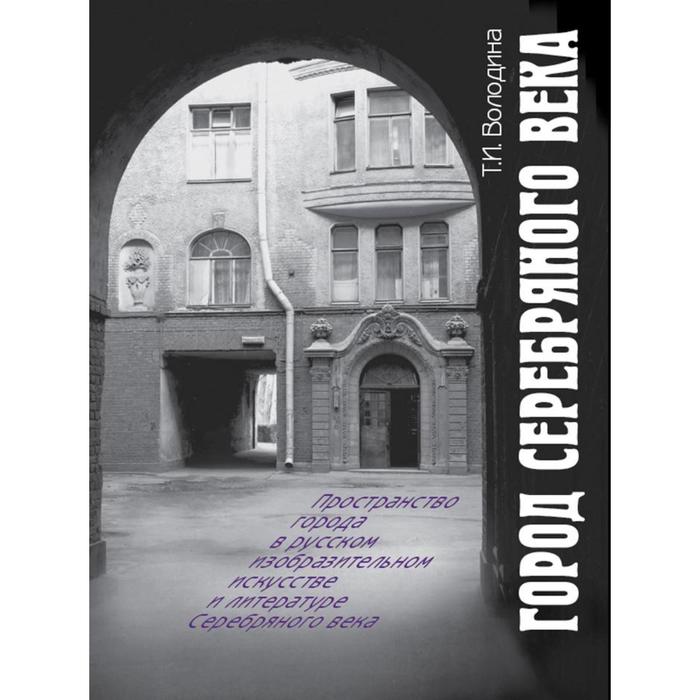
The city’s space in the Russian fine arts and literature of the Silver Age. The book is the first interdisciplinary study of the theme of the city of the first decades of the 20th century in the Russian visual arts and literature of this time in modern Russian science. A comprehensive approach to the topic, which is based on a structural analysis of the city space, allowed the author to build a new iconography of urban spatial images in the works of Russian literature and art, to recreate the thoughtful model of the city, as the writers and artists of the beginning of the last century saw it.
The book is richly illustrated, written by a clear, intelligible language with the involvement of the statements of artists, writers and poets who help to understand the reasoning and conclusions of the author. The book will be interesting not only to specialists - art critics, philologists and culturalists, but also a wide range of readers, connoisseurs The art and literature of the Silver Age.
At all times, the city, which is the focus of the creative potential of the era, seeks to comprehend itself. The situation of the late XIX - first decades of the 20th century confirms this truth. The city as a battery of basic ideas and the phenomena of industrial civilization could not but become one of the central, if not the main, motive for the work of artists and writers of the first third of the XX century.
In this work, an attempt is made to understand the understanding of the topic of the city in Russian art and literature of this time, to identify the range of ideas, motives and techniques within this topic, in other words, to show a certain cut of new urban iconography. For Russia, this circle of problems correlates with the two cities of the Hit find - St. Petersburg and Moscow. The attention of the author of the study is concentrated on the problems of organizing the space of the huge city of the first quarter of the 20th century from the point of view of the perception of this space by contemporaries - writers and artists.
The analysis of specific works discusses the modifications and features of the main modules of the city and architectural space, such as the street, house, window, doors, gates, arches. Significant for understanding the essence of the space of the new city is its advertising component - city signs, designed to be guidelines in the city for its purpose, but in fact often distorting beyond recognition of its street. It is necessary to add such an important element as a crowd to these components of urban space, because the metropolis of the beginning of the 20th century does not exist and cannot be understood outside the connection with the phenomenon of “humanamy”.
, individual chapters of this work are devoted to all these structural components (parts) of the city space. Based on the analysis of a large number of works of literature and art, the author seeks to build some semantic ranks, which together allow us to understand how the creators of these works saw urban cosmos. And if in the first introductory chapter dedicated to the space of the city as a whole, the author speaks of some kind of sensation of the city as a prison for the creative consciousness of the era, then in subsequent chapters with their more targeted approach, within the framework of narrower topics, we are talking about variable interpretations within these specific those. The last, final head of the work was given to the consideration of holistic individual images of the city, belonging to the largest masters of the pen and brush of the first quarter of the 20th century, whose work is closely related to the theme of the city. The analysis of many works allows us to talk about a certain conceptual unity in resolving the issue of the fate of the modern city by artists and writers of those years.
The author’s preferences when choosing personalities are given to such recognized urbanists in this work as Andrei Bely and Mstislav Dobuzhinsky, as well as those writers and artists who managed to create convincing images of the city of the early 20th century. However, the list of writers and artists attracted by the author and the names of works is very extensive.
The brackets of this work consciously made the questions of the influences of European literature and art of the late XIX - early XX centuries on the work of Russian writers and artists. This is a voluminous task for a special study. But, of course, the author remembers that the European cultural context is very significant for its Russian counterpart.
Russian literature and Russian art almost synchronously turned to the theme of the modern big city with European ones, but went their own ways in its understanding, and their individual representatives became pioneers on these paths.
| Characteristics | |
| A country | Russia |
| Author | Volodina Tatyana |
| Kit | No |
| Number of pages | 335 |
| The year of publishing | 2017 |
| Type of art | Applied |
| Type of cover | Hard cover |
There are no reviews for this product.