What will the didactic game teach?
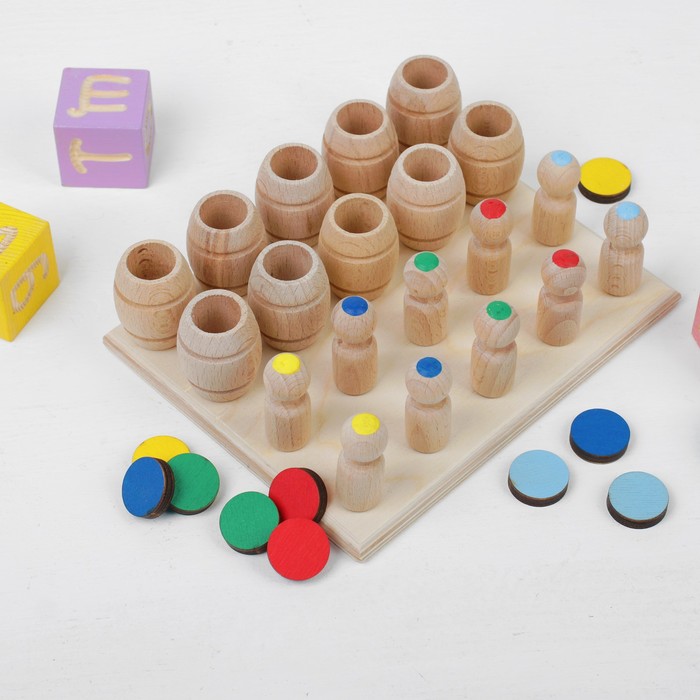
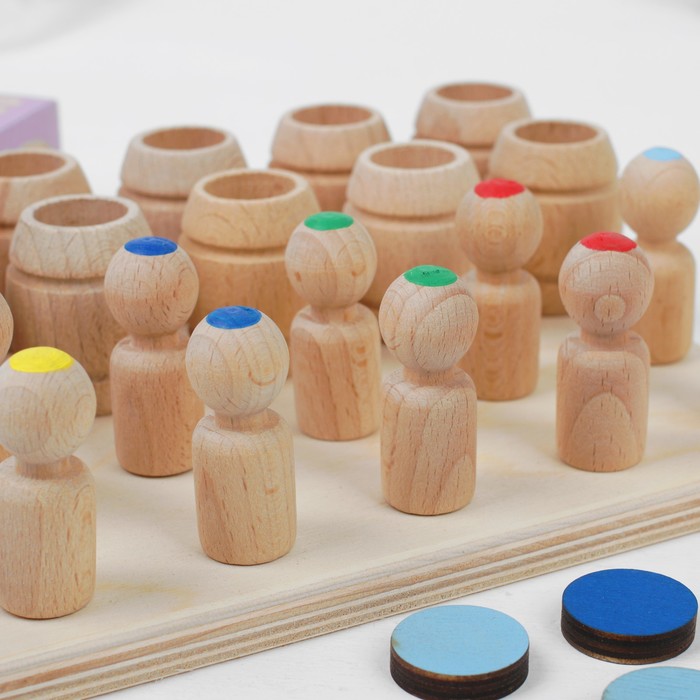
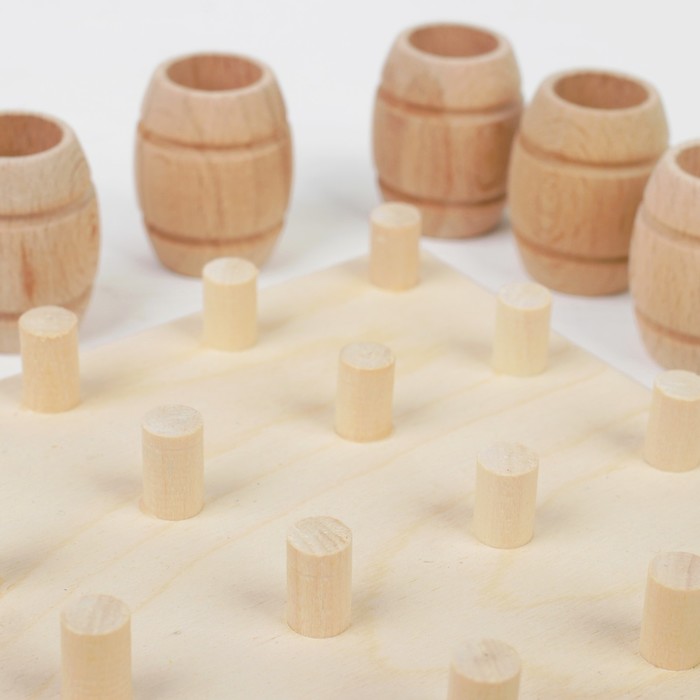
will form in children the concepts of “one-many”, “right-leve”, “intra-sorod”. will teach kids the basics of an orderly and quantitative account, will help to master different mathematical actions to distinguish, distinguish colors and distinguish colors and distinguish. Select couples by color, will also lay the foundations of logical thinking. During the game, the child will learn to easily invest one item in another, string the figures on the pegs, manipulate the details of the game, improve fine motor skills, can be considered in the direct and reverse order to consider in pairs, he will learn to solve the logical problems of different difficulties, analyze your actions and much more. The game consists of a tablet with pegs, ten unpainted barrels, ten colored lins-lumps and ten men with different color caps (two each color).
Games for children from 1 year to 2 years.
"Funny passengers." The adult puts an empty tablet on the table and says that the ship approached the shore. The child’s task is to immerse onto the boat at first of all passengers, and then a load, that is, barrels. “Ship is drowning!” The men float on the tablet-ship. There are also barrels there. But suddenly a storm begins and the ship can drown. The baby’s task is to save passengers, that is, remove the barrel from the pegs, put on the table and transfer each man from the tablet to the barrel so that they do not drown with the ship. “Find the brother” (or “Find a couple” ) Put five men on the tablet. All of them should be with different hats. Invite the baby to find a twin brother. If the task is too simple, then ask the child to “put” each man on the chair of the corresponding color (for this use colored circles). “We count to five!” An adult puts on a barn on the tablet, and loudly believes: one, two, three, four, five! He offers the child to do the same with his barrels, and also count them. Then, together with the baby, we put the men in the barrels (you are our own, and he is our own): one, two, three, four, five! Pay the child’s attention to the fact that how many barrels he has, so many men can be planted in them. In each-one man. Games for children age: 3-4 years.
“Who is faster” for two players, you can speed. Separately barrels and little men, aton -free, are placed on the tablet. The barrels are covered with lids of different colors. Children should remove the lid from the barrel as quickly as possible, put the barrel on the table, put a man in it and put a barrel with a man on the same lid. The main thing is that the color of the cap coincides with the color of the lid! Each child puts barrels with men on his part of the tablet. At the end of the game, you can see who collected more barrels and did not mix up the color. “Military landing”. The game reverse of the previous one. Soldiers are sitting on the raft in the barrels (color-revolutionary). It is necessary to put the little men in pairs in color next to their barrels. And close the barrels with the appropriate lids. "Fourth extra." We play with the child in a simple logical game. An adult puts four figures on the tablet, for example, three barrels and one are placed on a circle, and one without a circle. What is superfluous? Or three barrels with a man inside, and one without. Fantasize yourself and invite the child to come up with tasks for you. And at this age we learn to count up to ten and vice versa, we study the concepts of “pair”, “on the left”, “right”, “between” Games for children age: 5-6 years old.
"Three in a row." This is a simple game of the type of nolly crosses. Two players take turns putting figures to the tablet. One player-piece, another-human. Those who will build three identical figures in a row have won. A little more complicated is the option “four in a row.” “Who is more?” This is a variant of the game "Memory" for the development of visual memory. All barrels with men inside are placed on the tablet. Only the little men are turned their heads down so that the color is not visible. The first player takes out two men, demonstrates everyone and, if their color coincides, takes himself, if not, he puts it back. The second player also takes out a couple of men and repeats manipulation. The task of the players to collect paired figures in color, remembering in what barrels they are. The one who has more couples at the end of the game wins. "Just not nearby!" Playing the development of analytical abilities, the ability to compare, combine, predict the result. The task at first glance is very simple: it is necessary to arrange ten men in two rows so that the same colors never be near (neither on the right, nor on the left, nor diagonally). School is a very important thing. And our game is also a wonderful didactic material. Invite the child to make simple examples for addition, subtraction, use mathematical signs (+,-, =,>,