
Lotto "Profession" 42 chips, 7 cards: 22.5 × 13.5 × 5 cm
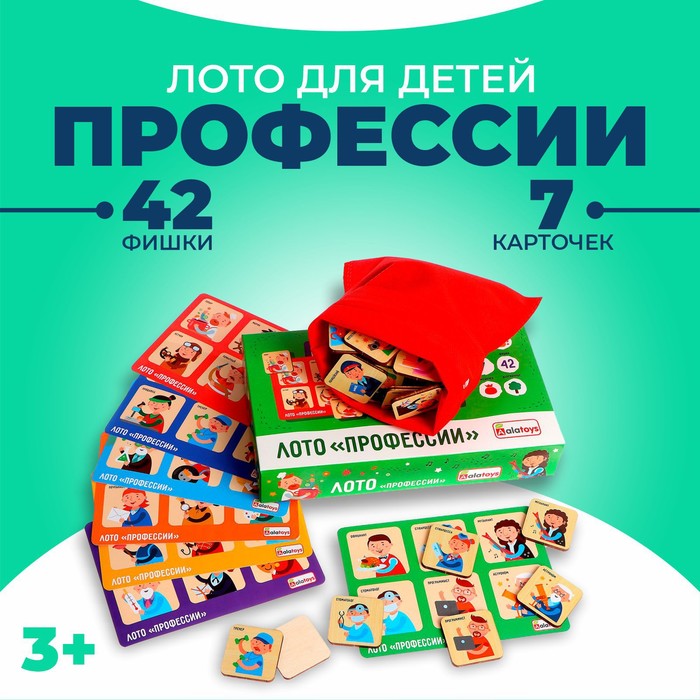
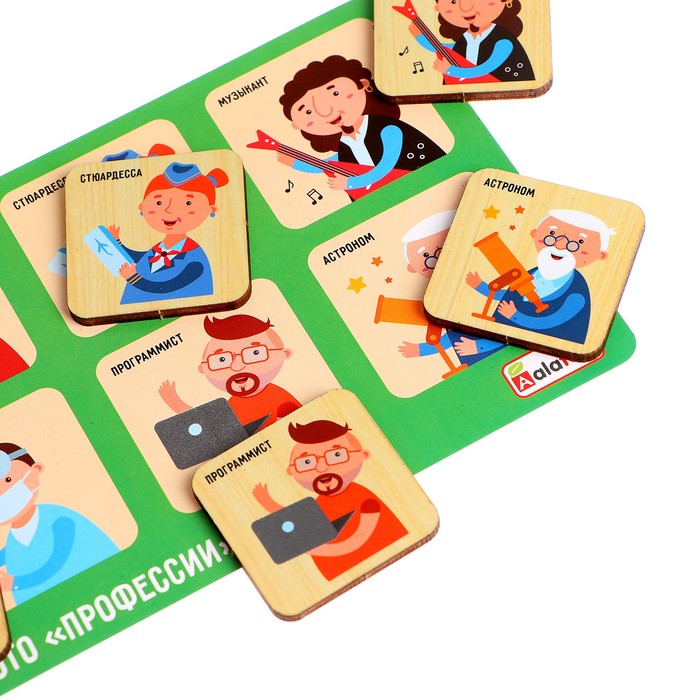
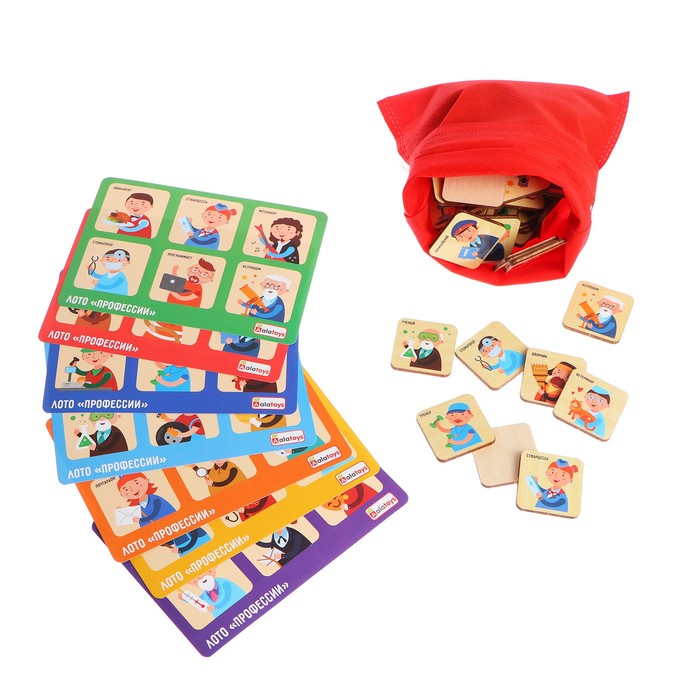
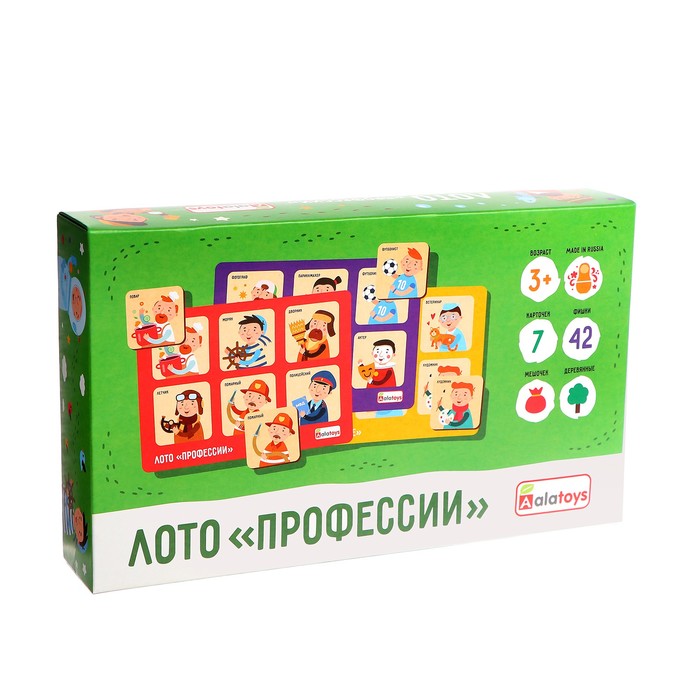


Loto is a developing game that will introduce your baby to the world of professions. All chips are folded in a bag, the players are heard cards, and the host takes out the chips from the bag, and the players cover them with matching pictures.
Options for gamesThe purpose of the game: to consolidate the names of actions performed by people of different professions.
The course of the game: the child takes one card, and the adult - signs with the image of people of professions corresponding to the card. An adult asks a question, calling an action that a person of a particular profession performs (for example: who heals people?). The child responds with a complete sentence (the doctor treats people). Then he receives a sign and puts it on the image. When all the images are closed, the child says who is doing what. The game can be continued with other cards.
Purpose: to expand children's ideas about labor actions, to develop attention, thinking, imagination.
The course of the game: all the signs are folded in the bag. Each player takes out one plate. In turn, players are trying to portray with actions, without words, the profession that fell to them. The player who was the first to guess the name of the depicted profession takes a sign to himself. Further, another player shows his profession, and the rest guess. The game continues with new signs. The one who guessed the professions, who has the most tablets, wins the most.
Purpose of the game: Development of visual and auditory attention.
The course of the game: All figures are folded in the bag. Players are distributed cards. A presenter is appointed, who takes turns taking out one figure from the bag and calls it. Players look at whether this image is on their cards. The task of the players is to collect all the figures on their card as soon as possible. You can complicate the game by putting more cards in front of the player.
You can also complicate the game as follows: the host takes out the figure and does not call who is depicted on it, but describes the activity of this profession. Players, guessing who we are talking about, see if there is a necessary image on their card.
The purpose of the game: training of visual memory, the ability to change the word in the genitive case.
The course of the game: An adult lays out a child in front of the child with images of people of different professions, the child calls them (for example: an artist, builder, cook). Next, the adult asks the child to remember them and close their eyes. At this time, the adult removes one of the figures (for example, a cook) and asks the child to open his eyes and say who was gone. (The answer is a complete proposal: there was no cook). Depending on the abilities of the child, you can increase the number of figures that must be remembered, or the number of cleaned figures.
Purpose of the game: training of visual memory, the ability to remember the sequence of objects.
The course of the game: A few signs with images of people of different professions are laid out in front of the child, it is proposed to remember in what sequence they are and then close their eyes. At this time, the adult rearranges two signs in places, asks the child to open his eyes and say what has changed (for example: the artist and the cook have changed places) and decompose in the sequence as it was originally. You can complicate the game by increasing the number of figures laid out and the number of figures that change their place.
Purpose of the game: Development of auditoral memory.
The course of the game: An adult gives the child several tablets with images of people of different professions (3-4 pcs.) And offers to put them in a row in the sequence in which he will say. (Example of the instructions: Put first a doctor, then an actor, then a teacher). The child lays signs in a row. The adult checks by spoke the sequence again. If there are mistakes, the child, having heard the correct sequence, changes the figures. If it is difficult for a child to remember the sequence by ear, ask him to speak it after your instructions, and then lay out.
This game can be held on cards. With the same instructions, only laying out not in a row, but according to images on the cards. It is better to start playing with two figures, then with three. Only when the child will easily memorize a sequence of three figures can you proceed to four. Thus, the volume of auditory memory will increase gradually.
the purpose of the game: to consolidate the knowledge of children about materials, tools, equipment, necessary for people of different professions, the development of visual memory, to learn to use words in a vinological case.
The course of the game: An adult invites the child to consider one card with images of people of different professions and say who holds what in their hands. The child responds with complete sentences (for example: the doctor holds a thermometer) and so on. Then the card is turned over and the child is invited to remember what was in the hands of everyone. For each correct answer, an adult gives the child an appropriate sign with the image of a person of this profession. So the child checks the correctness of his answer. If it is difficult for a child to remember, you can ask a leading question (for example: who keeps a thermometer?).
The purpose of the game: enrichment of the vocabulary, the development of phonemic hearing (the ability to hear sounds in the word), the study of letters.
The course of the game: an adult begins the game, calling a profession (for example, a janitor). The child should come up with and name the profession in the last letter of the word (for example, confectioner) and so on in turn. At the same time, each player takes a figure of a named profession.
In this case, figures with names can serve as a visual support for children: reading children can read the names of animals on the signs and choose a word starting in the desired letter. If the child does not know how to read, an adult can write this letter on a piece of paper and ask to find a printed word where this letter is at the beginning.
The purpose of the game: to learn to divide words into syllables.
The course of the game: An adult offers to divide signs with images of people of different professions into four groups, depending on the number of syllables in the word. At the same time, there can be pops-how many cottages, so many syllables (for example: a doctor-one syllable, in the vvar-two syllables, u-chi-three syllables-four syllables-a hundred-ma-ma-log). Next, you can count how many words in each group turned out.
| Characteristics | |
| A country | Russia |
| Age | From 3 years |
| Development of skills | Logics |
| Material | Tree |
| The topic of training | The world |
There are no reviews for this product.
Tags: Lotto (toys), lotto (holidays), early development methods (children's goods)