
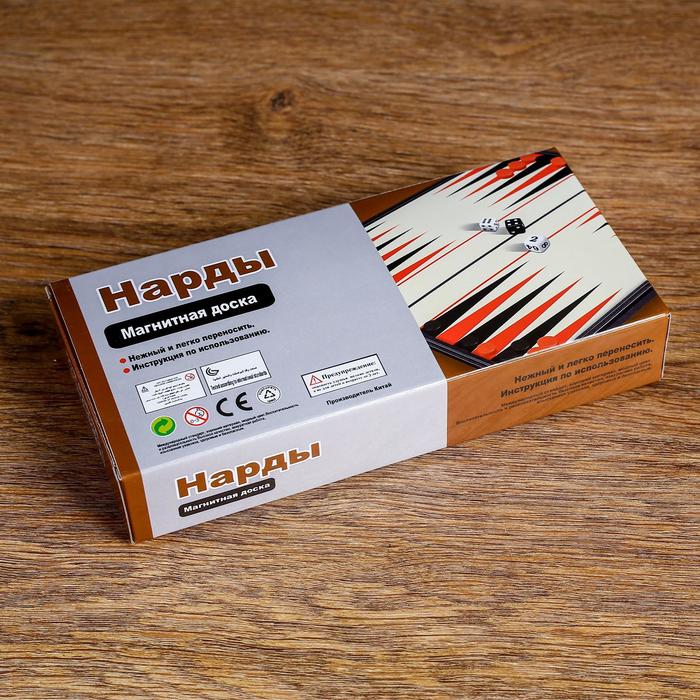
Magnetic backgammon, field 20 × 20 cm, in box
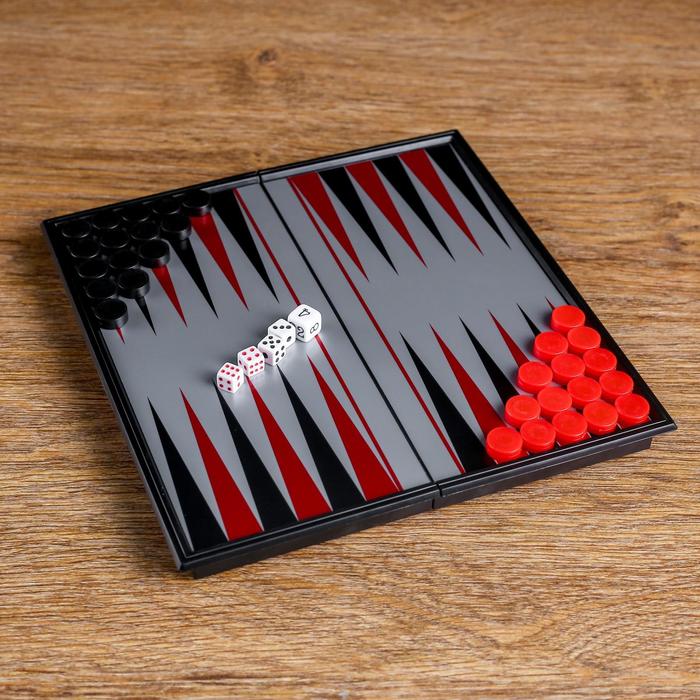
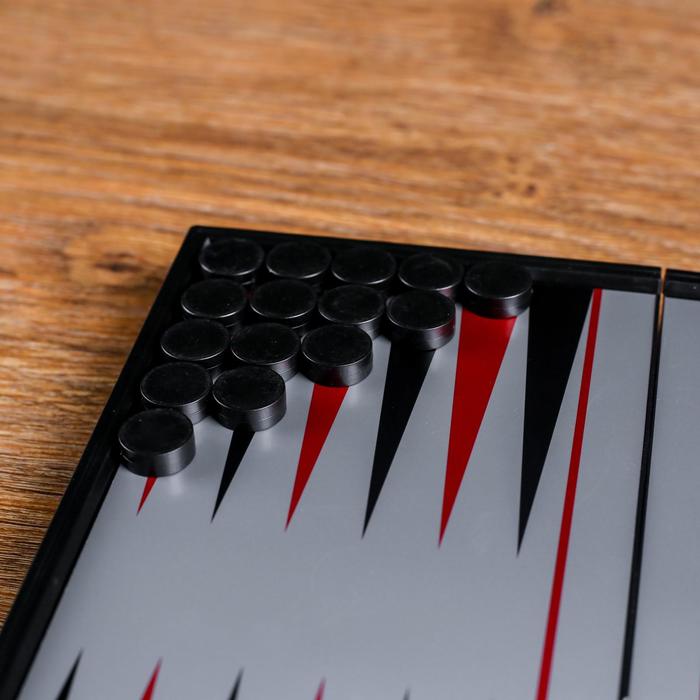
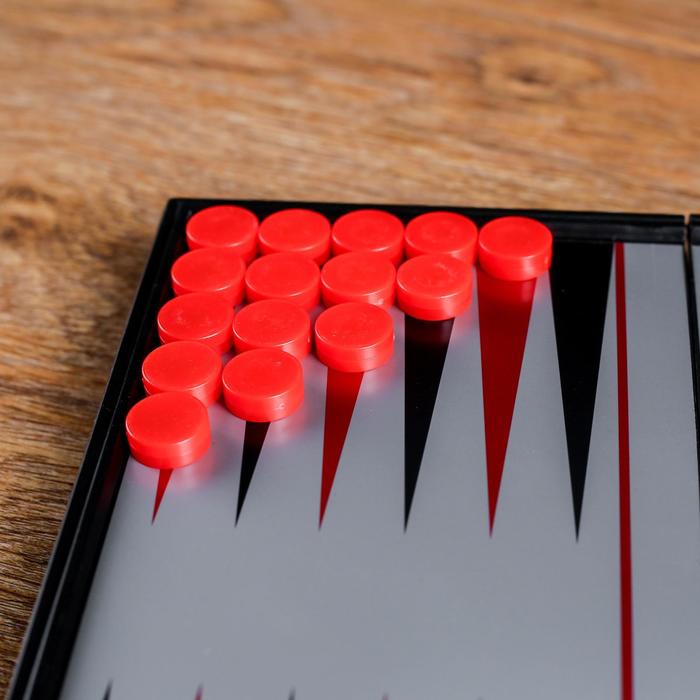

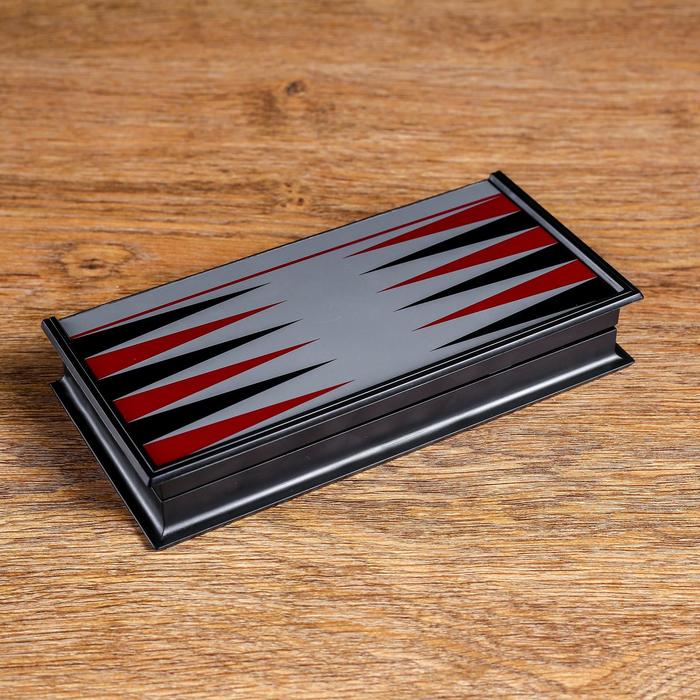


when playing backgammon use
- checkers in an amount of 30 pieces. Each player has 15 (there are types of game and less) checkers of his color. For example, white and black, or green and yellow. The main thing is that the color difference is clearly visible.
- Zara, or playing bones, these are ordinary cubes with dots on faces (from 1 to 6). The amount of salary is 2 pieces. It is advisable to run up new bones: they produce 100 - 200 shots and fix it, which has fallen. The same thing is sometimes worth doing with those rations that are regularly used in the game. On good rations, all glasses fall about the same number of times. Needless to say, this factor when playing backgammon is very important. Good, accurate bunks can cost up to $ 30.
- Cuba Cube: a special cube showing the game rate, the degrees of deuces are indicated on its faces: 2.4,8,16,32,64. At the beginning of the game, he should show 64.
- a cup for throwing cubes: a common or its own for each player/
- board: a game field on which, according to the rules, checkers move. Often the board is a work of art - it is made of rare wood or high -quality synthetic materials. It is decorated with carved ornaments, various inlayers, including elephant bone, precious metals and stones. The price of a board on free sale can reach up to several thousand dollars.
the board of backgammon consists of 24 narrow elongated triangles called "points". Items from 1 to 24 are numbered, and for each player his own numbering. Where one player has 24 points, the other has 1, and so on.
conditionally the game field is divided into four quarters, six points each. These quarters are called - house, courtyard, enemy house, enemy courtyard. The house and the yard are separated by a special side, which protrudes above the gaming field and is called bar.
The rules for moving the checkersThe rules for moving the checkers vary in different types of backgammon. However, the movement of checkers is always subordinated to 2 stories - how many glasses fell on them, and checkers move so much. Glasses on Zavat are not summarized: first you need to move the checker to the number of points that fell on the same bone, and then - the number of points that fell on the other. When a double falls (equal value on both ears), the number of points on which you can move the checkers doubles.
The purpose of the gamethe goal of the game is to, throwing the Zara in turn, in accordance with the falling number of points, go through the checkers a full circle (counterclockwise), go into the house and throw the checkers before the opponent does. Usually they play for money for money, at a rate set for one point. According to the rules for one game, you can win more than one point, if there were a doubling of bets or the game ended with Mars or Cox. You can play both separate batches and matches consisting of several games. See unfamiliar terms in the dictionary.
There are dozens of options for the rules of the game backgammon, but they are all divided into two large classes: long backgammon and short backgammon. The main difference is that in short backgammon, you can knock other people's checkers.
Long backgammonlong backgammon is one of the main options for the game in backgammon. Each has 15 checkers on its part of the board along the left side. Checkers in the starting position are called "head". Making a move from the initial position means "taking from the head." From the head it is allowed to take only one checker in the course. When playing in long backgammon, the movement of the checkers occurs counterclockwise.
The beginning of the gamethe right to walk the first in long backgammon is determined as follows: each player throws one zara (cube) who has more - walks first. With the equality of the fallen glasses, the dawn is thrown again. If after one batch they immediately play another, then the winner begins it. Zara is thrown alternately in such a way that both of them fall in one half of the gaming board and steadily lay on the face. If the cubes scattered into both halves of the board, if at least one of them fell outside the boards, or even stood askance, leaning against the side or checker, the throw is repeated. In the game “Long Neds”, you can declare an opponent’s throw invalid by saying the word “kestum” directly when throwing or before it starts.
The goal of the gamein long backgammon, the player should go through all the checkers a full circle (counterclockwise), go into the house and throw them away before the enemy does. The house for each player is the last quarter of the board for the movement of his checkers (from 19 to 24 points).
In the game, the player throws long backgammon in the game two cubes at the same time. After the throw, the player moves any saber to the number of items equal to the number of the number at one dawn, and then the same or any other saber - by the number of points that fell at the other dawn. For example, if “two” fell on one cube, and on the other “six”, then you can move one of your checkers by two points, and the other by six, or you can move one saber to all eight points. Which move is the first to make, a larger number or smaller, does not matter.
From your head you can take only one saber. Exception: cases when one should not go with a saber (“it falls into the head of an opponent”) is dubla: six or six, four or four, three or three, then go with two checkers. For the second player of the options for falling out, in which two checkers can be removed from the head, there may be more, since the opponent will also interfere with the “head” of the opponent that he has already removed. If the enemy first threw two-one, six or two or five, then the second player can remove the second saber also during the throws five to five and six to two. The first move in long backgammon provides each player with an exception to the above rule. In the first course, the player has the right to remove two checkers from his head.
When an equal number of points was thrown out on both eazes (Dube, Kush, Pash, Gosh), the player plays as if he had thrown 4 Zara and can make 4 strokes per number of points that fell on one cube. When playing one item, you can put as many checkers as you like. You can’t put your own on an item occupied by the enemy’s saber (the checker does not go ”). If other people's checkers occupy all six cells in front of another saber, then it becomes locked. In the game, long backgammon is not forbidden to build blocks of 6 checkers, but all fifteen enemy checkers cannot be locked. The device of an inextricable chain of six checkers is a perfect result for an obstacle to the movement of enemy sabers. There is a variant of the rules: a fence of six checkers can be done only if at least one of the opponent’s checkers went into the house.
Based on the above, we can say that the tactical task of each player is to take as many points as possible with his checkers, in order to limit the movement of the opponent’s checkers. In a situation where the checkers do not go, that is, the player cannot move them for the number of holes that fell on Zazg (checkers fall on the busy holes), the glasses disappear, and the player misses the move.
The player cannot refuse a possible stroke, even if he is not beneficial to him. Also, the player cannot and reduce the course, for example, instead of 6 to go 3. In a situation where the player can perform any of the two moves, but only one, he must make more, smaller glasses burn out. There is a game option where in such a situation the player has the right to choose. The winning in this game is the one who is the first to pass the full circle and, being in the house, will throw away all his checkers. The loser pays a bet set before the game.
Throwing out the"throwing checkers" means to make the moves after which the checker is outside the board. The player can start throwing checkers only when all his checkers came to the house. In the game, long backgammon can only be thrown out from points, the numbers of which correspond to the glasses that fall on Zazhki. For example, if 6-3 fell, the player can remove one saber from the board from the 6th point and one saber from the 3rd. In the game, long backgammon can be removed from the fields of a smaller value than it fell on Zazza, only if there are no valuables in the fields of the dropped value. For example, 6-5 fell on Zales, and there are no checkers on the fields 6 and 5, then you can take two checkers from the next - the fourth field, and if there are no checkers, then from the third, and so on.
The results of the gameof a draw in the game are long backgammon. Who was the first to throw the checkers - the winner.
Long backgammon with DAVAwhen playing with DAVA, each of the players can offer the enemy to surrender or raise a bet, while raising the rate by agreement may not only be exponentially (2-4-8-16...), but also in arithmetic (1.2.3.4...). At the beginning of the party, every player has the right to such an offer. After raising the rate at the request of one of the rivals, this is the right, and with it the doubling cube, goes to another. In other words, the proposal to increase the rate is transmitted in turn. When playing in long backgammon with Dava, there are no options for Mars and Oin.
Game names of dropping numerical combinationsDu-Yak-2: 1; SE-YAK-3: 1; Se Bai Du - 3: 2; Chary-Yak-4: 1; Chari-do-4: 2; Chary-SE-4: 3; Pyanji-Yak-5: 1; Pyanji-da –5: 2; Pyanji-SE-5: 3; Pyanji-Char-5: 4; Shesh-Yak-6: 1; Shesh-do-6: 2; Shesh-SE-6: 3; Shesh-Char-6: 4; Shesh-Besh-6: 5; Yagan –1: 1; Du-bar-2: 2; Du-SE-3: 3.
| Characteristics | |
| A country | China |
| Class/chess field | No |
| Material | Plastic |
| Peculiarities | Road |
| Size | Small (up to 40 x 40 cm) |
| Theme | Classic |
There are no reviews for this product.
Tags: Backgammon (toys)