
Oats seeds, my choice, 1 kg
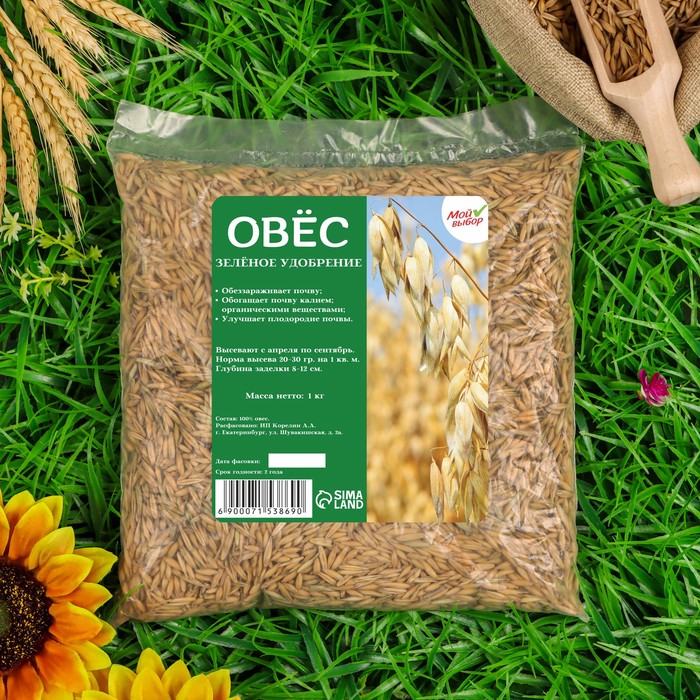
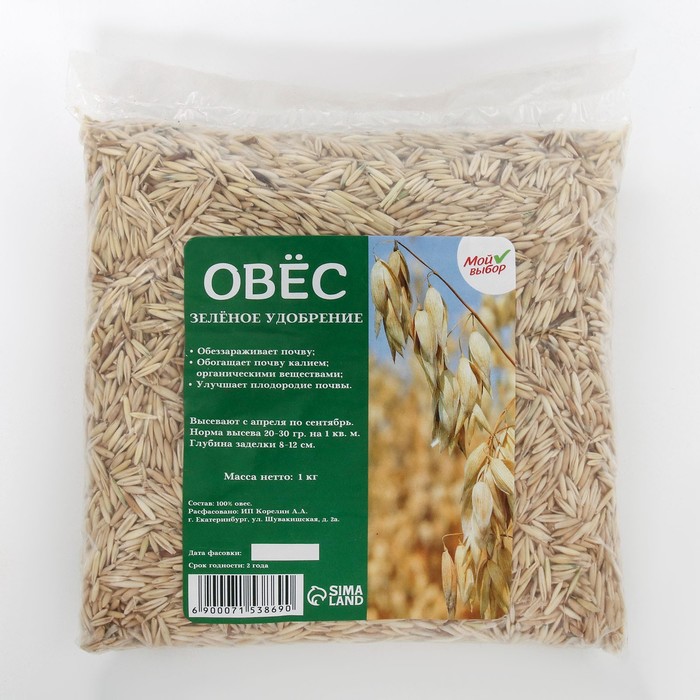


The representative of the cereals, which belongs to early cultures and grows everywhere in the conditions of a moderate climate in the form of a loose bush, which has leafy stems up to 120 cm high. Oats are grown both as grain and green fertilizer. He is not afraid of low plus temperatures, which allows him to sow it in early spring, when the soil reaches physiological ripeness. However, unlike rye, oats cannot tolerate frosts. Oats also belongs to thermophilic cultures, but unpretentious to the type of soil - it grows on loams, chernozem, peat, clay and sandy soils.
Oats are used to side the soil, which is due to its following properties: it has especially nutritious stems that contain more valuable protein than alfalfa and clover. The autonomic mass contains more potassium and phosphorus than nitrogen. In terms of the content of nutrients of biomass, cereal is commensurate with manure, but there are fewer nitrogen compounds in this organic matter. It should be noted that the number of elements depends on the age of the plant: the older it is, the more potassium is in it, but the nitrogen prevails in young greenery. In this regard, oats are cut off as fertilizer when it grows up to 20 cm in height. It has a blasphemous root system that strengthens light soils and loosens heavy ones. In addition, the resulting green mass of the plant makes the soil more air and moisture-resistant.
forms dense plantations - its stems are located close to each other, so weeds do not appear between them. Oats are drowned out, showing better competitiveness. If unwanted vegetation still appears, then it does not have time to form seeds before mowing biomass.
Harvest: gives a high harvest - from one hundredth of the site you can collect a mass equal to 100 kg of high -quality manure.
Features: With the help of oats, you can restore the running areas and launch them into crustacean, although it will take time for this-about 2-3 years. Gradually, the upper fertile layer will be restored, losing nitrates that were accumulated over the years of the use of mineral fertilizers. The Earth will gradually receive nutrients from Siderat, which will allow it to become more loose and moisture.
Winter hardiness: Oats belongs to cold -resistant and even cold -loving cultures, so it is advisable to plant it in the cool season: in the early spring. When snow comes down on the site, winter seeds can be planted. So, the optimal time of these work is the beginning of April or the end of March.
Sowing: Oats loves to grow in moist soil, so for planting it does not need to wait for the soil to dry (it should only warm up). The landing itself is recommended to be carried out about 2-3 weeks before planting the main culture, since the siderat is mowed during the formation of buds before the ties of the seeds, when it has a maximum of trace elements. In the early autumn. Oats are a cold -resistant, but not frost -resistant culture, so its landing must be done before frost. The plant ripens quite quickly-after about 30-40 days. The oats planted in the fall must be mowed and left right on the beds, slightly sprinkling with earth. This will make the soil loose and moisture. Oats can also be left inhabitants. In this case, it will rot in winter and converts into fertilizer. One plowing will be enough to grind and mix with the soil.
Consumption rate: 1.3-1.8 kg per hundred.
| Characteristics | |
| A country | Russia |
| Agronomic expiration date, years | 2 |
| Features of growing | Open soil |
| Sowing in the ground | May |
| The composition of lawns | Cereals |
| Weight, kg | 1 |
There are no reviews for this product.