
Set of busts "The rulers of the XIX century"
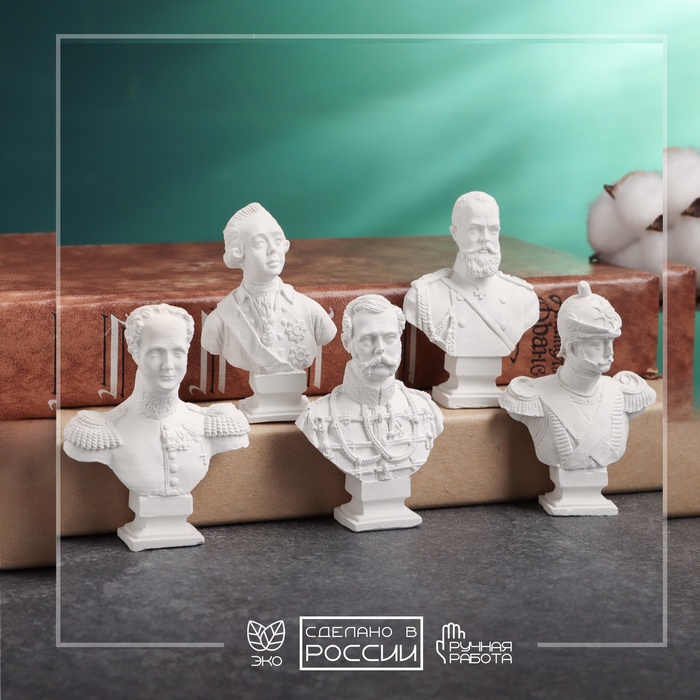

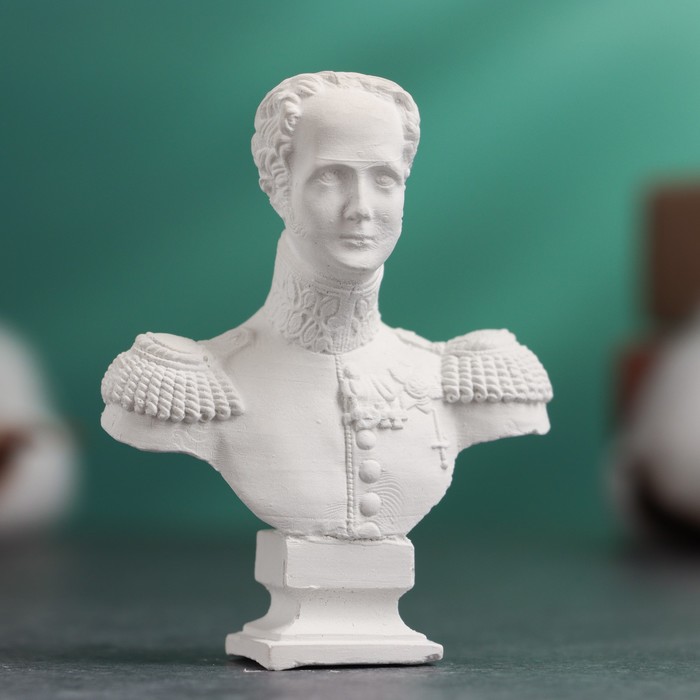


Bust "Emperor Alexander I"
Aleksandr I Pavlovich 1777-1825, the Emperor and Automobiles of the All-Russian since 1801, which carried out moderately liberal reforms in Russia. He was awarded a special epithet in Russian historiography - "blessed." The grandson of Catherine II.
Under Alexander I, a large -scale reform of public administration is carried out. An indispensable advice was created - an organ that could discuss and even cancel the decrees of the emperor. And the cabinet became the main administrative body of the empire.
He made great efforts to facilitate the situation of the Russian peasantry.
The reform of public education was carried out, with Alexander I, five universities and a large number of gymnasiums and schools were opened.
In foreign policy, he maneuvered between Great Britain and France, participated in anti -French coalitions. The winner of Napoleon I Bonaparte. He waged successful wars with Turkey, Persia and Sweden. Under Alexander I to Russia, the territories of East Georgia, Finland, Bessarabia, the former Duchy of Warsaw were attached.
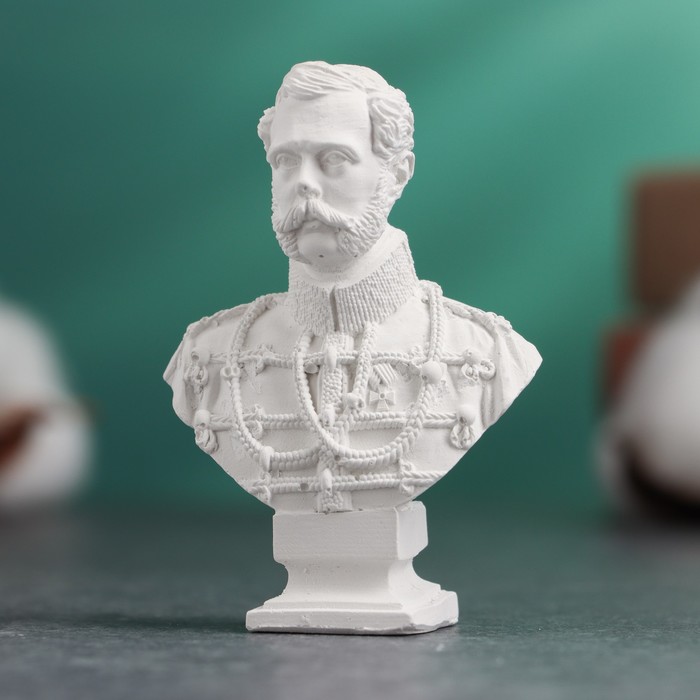
Bust "Emperor Alexander II"
Aleksandr II Nikolaevich 1818 - 1881, Russian emperor (1855-1881) from the Romanov dynasty, which carried out large -scale reforms.
A special epithet in Russian and Bulgarian historiography was awarded (in connection with the abolition of serfdom and victory in the Russian-Turkish war (1877-1878), respectively).
Serfdom was canceled in his reign, universal military service was introduced, zemstvos were established, judicial reform was carried out, censorship was limited, and a number of other reforms were carried out. The empire has expanded significantly due to the conquest and inclusion of the North Caucasus, the Far East, the territories of Central Asia.
died as a result of a terrorist act organized by the secret revolutionary organization "People's Volya".
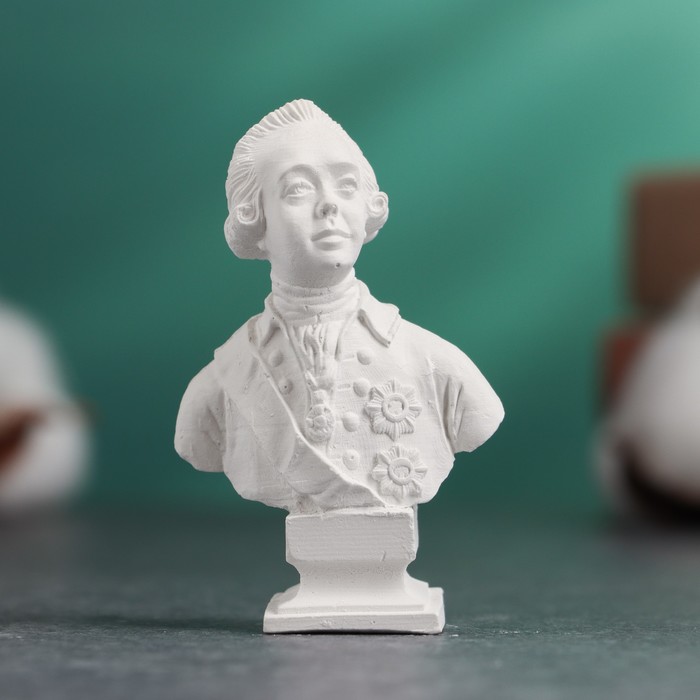
Bust "Emperor Pavel"
Pal I Petrovich 1754-1801, the Emperor of the All-Russian since 1796.
Paul became the emperor at 42. He had no special skills in conducting state affairs, which he compensated for his bright abilities. The first event held in the status of the emperor was the coronation of the late Peter III and its reburial in the Peter and Paul Cathedral, next to Catherine II.
The first document made after Paul's coronation was the Act of the throne. According to him, the direct descendants of the king along the male line became the heirs, and women could claim him only in the absence of a direct descendant.
Pavel I reformed the Senate, who could no longer cope with the increased volume of cases, and demanded to accelerate the work of all public services. The emperor did not find any special support in the noble class, since he tried to facilitate the position of the peasantry with some of his decisions.
In addition, he began an offensive on the privileges of the nobility and canceled some provisions (a ban on the application of bodily punishments in relation to the nobles) of the “complained letter to the nobility”.
From the very beginning of his main foreign policy task, Paul I considered the struggle with France in which the revolution occurred. Having united, Türkiye, Great Britain, Sicily and Austria organized an anti -French coalition.
Over time, all the actions of Paul I found more and more dissatisfied. On the night of March 11 to March 12, 1801, the conspirators broke into the chambers of the emperor and demanded his renunciation. Pavel refused, he was killed in the tied fight.
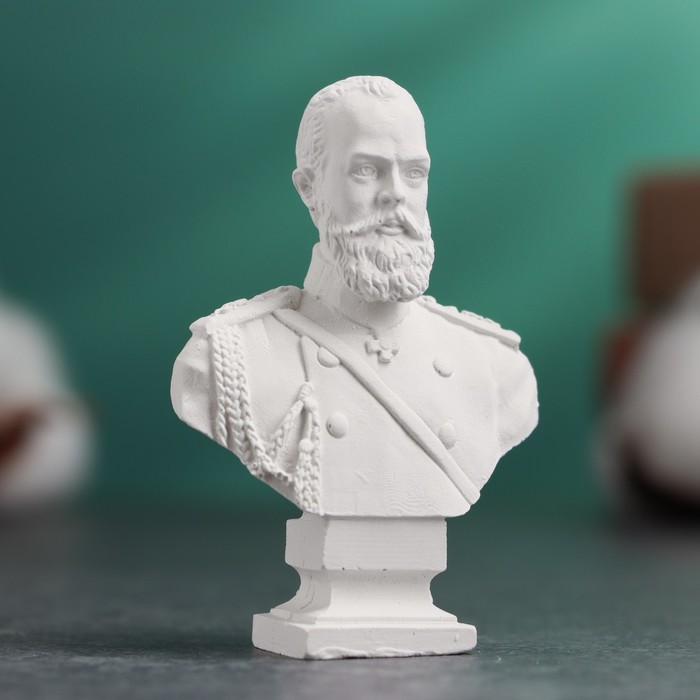
Bust "Emperor Alexander III"
Alexandr III Aleksandrovich 1845 - 1894, the Emperor of the All -Russian since 1881.
Alexander III made a significant contribution to the reconstruction of the system of state and public relations: he eliminated the autonomy of universities, and carried out reforms in the field of city administration. Under him, closed legal proceedings for political processes were restored, he sought to strengthen the role of local nobility in society.
great successes were achieved in the development of industry. The real technical revolution began in metallurgy; The release of cast iron, steel, oil, coal, from the mid-1880s to the end of the 1890s, increased with a record pace in the history of the pre-revolutionary industry.
In history, Alexander III went as a world king, since during the years of his reign, Russia did not participate in any serious military-political conflict of that time.
Bust "Emperor Nicholas II"
Nikolai II Aleksandrovich 1868-1918. - The last Emperor of the All -Russian from 1894 to 1917, from the Imperial House of the Romanovs.
The reign of Nikolai Alexandrovich began with a monstrous tragedy on the Khodynsky field on the occasion of the coronation of the emperor. As a result of the crush, more than a thousand people died, several hundred received injuries. In connection with these events, the people called Nikolai Bloody.
The time of the reign of Nicholas II was a period of the highest rates of economic growth in the history of Russia. Russia has become the main exporter of agricultural products, the first "Ginel of Europe".
According to the manifesto on October 17, 1905, the population of Russia received the right to inviolability of the individual, freedom of speech, press, meetings, and unions. Political parties grew in the country, thousands of periodicals were published. The parliament - the State Duma was elected free will. Russia became a legal state - the judiciary was practically separated from the executive.
The emperor attached great importance to the development of railways. Even in his youth, he participated in laying the famous Siberian road.
In the era of the reign of Nicholas II, monetary reform was carried out, the gold standard of the ruble was established, industry developed violently. Nevertheless, the defeat in the Russian-Japanese war of 1904-1905, as well as revolutionary movements led to the fall of the authority of the emperor. During the participation of Russia in the First World War, economic and political difficulties began to increase in the country. This led to the fact that on March 2, 1917, Nicholas II renounced the throne.
Already in the summer, by decision of the Provisional Government of Nicholas II, together with the family, he was sent to the link to Tobolsk. In the spring of next year, the Bolsheviks moved the royal family and all close associates to Yekaterinburg, where in July 1918, in the basement of Ipatiev’s house, they shot.
| Characteristics | |
| A country | Russia |
| Coating | Without cover |
| Color | White |
| Height, see | 7 |
| Kind of activity | Political figure |
| Material | Gypsum |
| Personality | Pavel I |
There are no reviews for this product.