
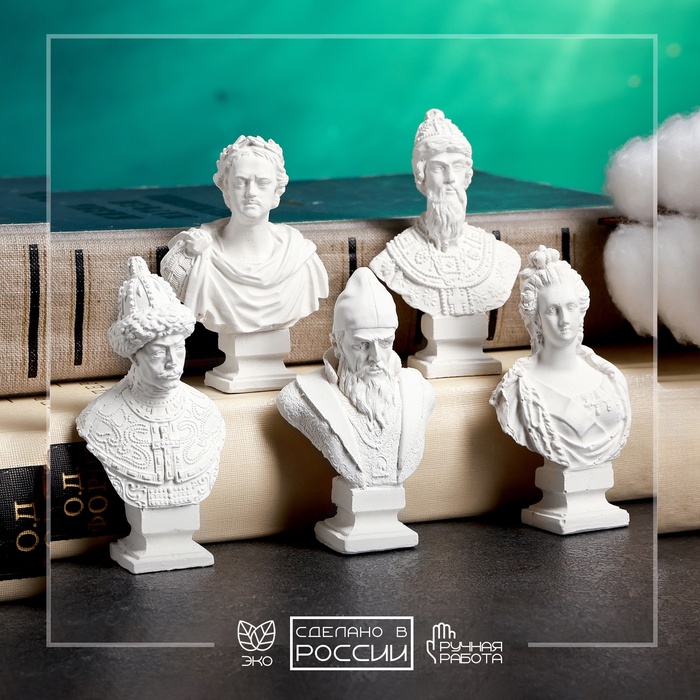
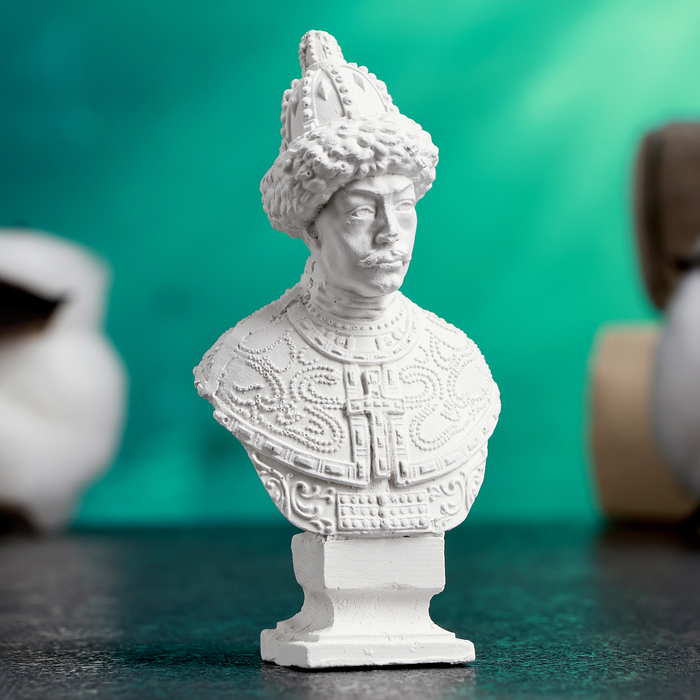
Set of busts "The rulers of the XVI-XVII centuries"
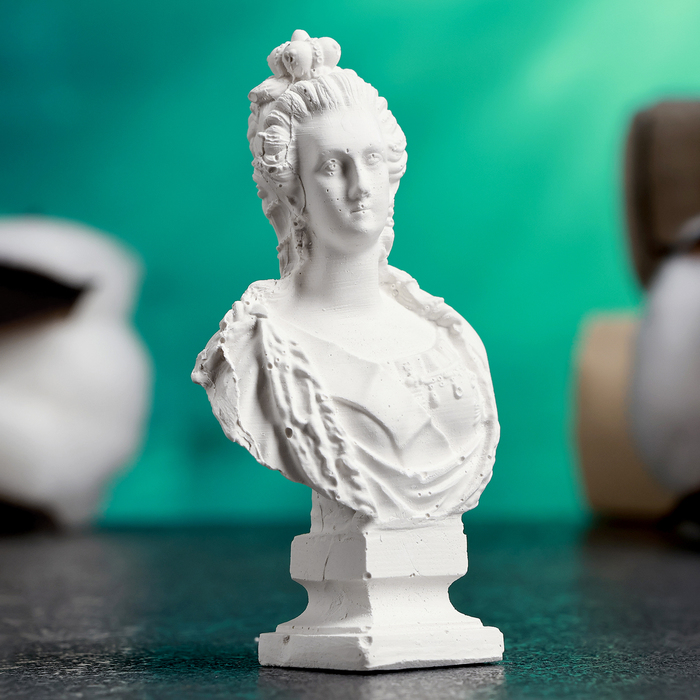


Bust "Empress Catherine I"
Ekaterina I, 1684 - 1727, the Empress All -Russian since 1721 as the wife of the reigning emperor, since 1725 as the ruling sovereign; The second wife of Peter I.
For 2 years of the reign of Catherine I Russia, Russia did not wage large wars, only in the Caucasus there was a separate corps under the command of Prince Dolgorukov, trying to recapture the Persian territories while Persia was in a state of troubles, and Turkey unsuccessfully fought with Persian rebels. In Europe, Russia showed diplomatic activity in defending the interests of the Golstein Duke (husband of Anna Petrovna, daughter of Catherine I) against Denmark.
Another area of Russian policy under Catherine was ensuring the guarantees of the Nistadt world and the creation of an anti -Turkish bloc. In 1726, the Government of Catherine I entered into a Viennese union agreement with the Government of Charles VI, which became the basis of the Russian-Austrian military-political alliance of the second quarter of the 18th century
When the empress was dangerously rang, a will was in a hurry, according to which the throne was inherited by the grandson of Peter I, Pyotr Alekseevich.
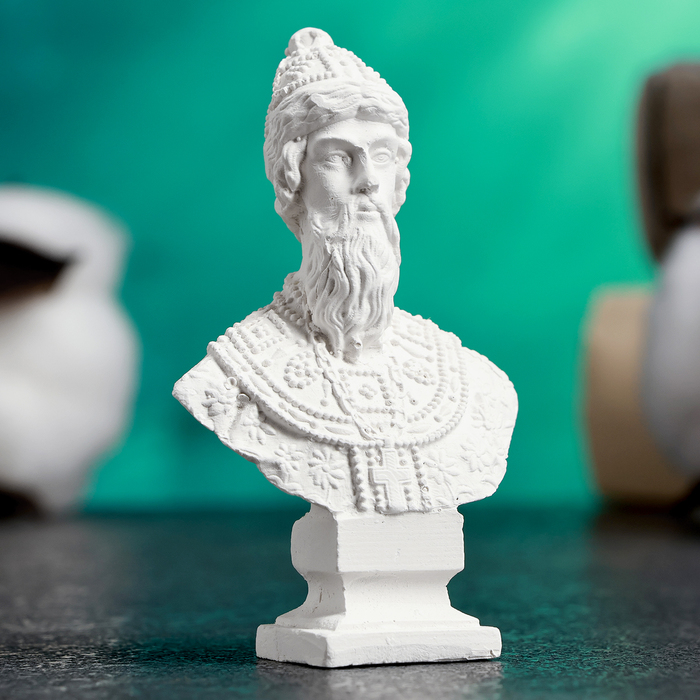
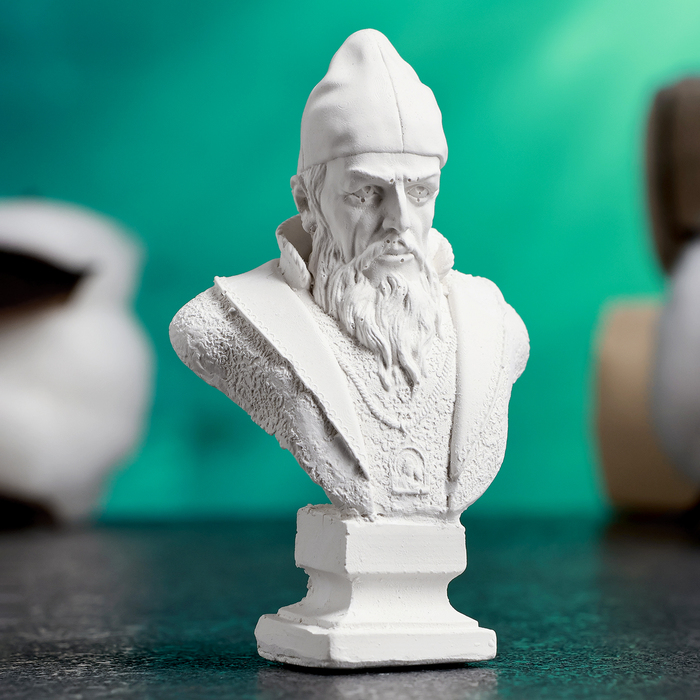
Bust "Tsar Ivan the Terrible"
Ivan IV Vasilievich, nicknamed Grozny, 1530-1584. - Sovereign, Grand Duke of Moscow and All Rus'
Ivan IV Grozny since 1533 became the first Russian king, doubled the territory of the possessions of Moscow and the rules of 50 years - longer than any other ruler of Russia.
Since the end of the 40s, rules with the participation of the chosen Rada. Under him, the convocation of the Zemstvo cathedrals began, a Judicial Code of 1550 was compiled. Directorate and court reforms (Glubnaya, Zemskaya and other reforms) were carried out. In 1565. Oprichnina was introduced. Under Ivan IV, trade ties with England were established, the first printing house in Moscow was created. The Kazan and Astrakhan Khanates were submitted.
The Livonian War was waged for access to the Baltic Sea, the annexation of Siberia began. The domestic policy of Ivan IV was accompanied by mass dumps and executions, an increase in the enslavement of the peasants.
Ivan IV went down in history not only as a tyrant. He was one of the most educated people of his time, possessed phenomenal memory, theological erudition. He is the author of numerous messages (including Andrei Kurbsky), music and the text of the holiday of the Vladimir Mother of God, the canon Archangel Mikhail. The king contributed to the organization of printing in Moscow and the construction of the church of Blessed on Red Square to commemorate the capture of Kazan on October 2, 1552
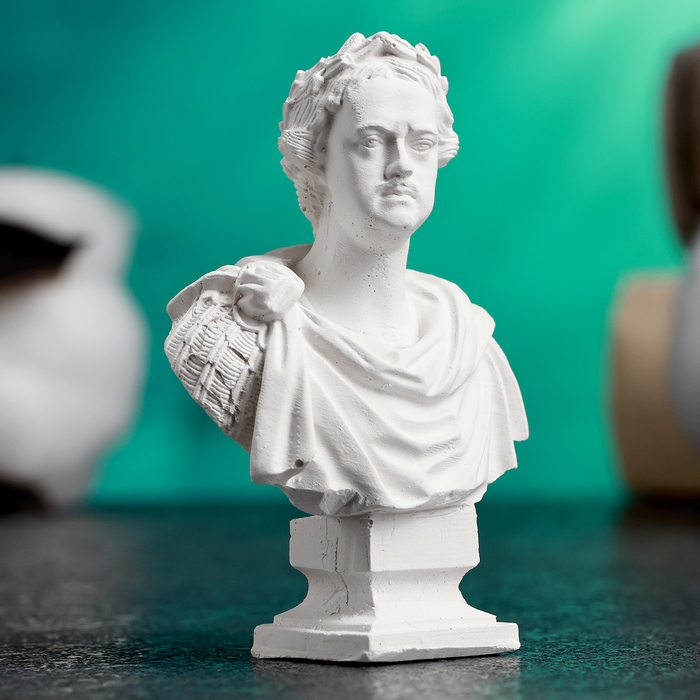
Bust "Emperor Peter I"
Peter I Alekseevich, nicknamed Veliky, 1672 - 1725 - The last king of all Rus' (since 1682) and the first Emperor of the All -Russian (since 1721).
Peter I carried out reforms of public administration, the church was subordinated to the state, the country was divided in the province, a new capital was built-St. Petersburg.
used the experience of Western European countries in the development of industry, trade, and culture. He headed the army in campaigns and wars.
He led the building of the fleet and the creation of a regular army. Contributed to the strengthening of the economic and political situation of the nobility. On the initiative of Peter I, many educational institutions, the Academy of Sciences were opened, civilian alphabet has been adopted, manufactories, metallurgical, mountain and other plants, shipyards, marina, channels have been created.
Being the creator of the powerful absolutist state, Peter I achieved recognition by the countries of Western Europe by the authority of the great power.
Bust "Tsar Alexei Mikhailovich"
Alexei Mikhailovich The Quarte 1629-1676. The second Russian king from the Romanov dynasty, since 1645, the son of Mikhail Fedorovich and his second wife of Evdokia.
Praise the “talh” king in the “rebellious” century, Alexei Mikhailovich, according to historiographic tradition, was not an active sovereign, the degree of his participation in the adoption of the most important political decisions to historians is reliably not known, not known to historians,
The strengthening of the autocratic, unlimited power of the king continued, in the second half of the 17th century. Zemsky cathedrals were not convened, but the ordered control system reached the heyday, the process of its bureaucratization was intensively. A special role was played by a secret order in 1654, subordinate directly to Alexei Mikhailovich and allowed him to lead other central and local institutions.
In the reign of Alexei Mikhailovich, a split of the Russian Orthodox Church also occurred.
The strengthening of the dependence of the peasants on the landowners as a result of the establishment of an unlimited detect of fugitive peasants led to the discontent of the Cossacks. In 1670-1671 A uprising led by Stepan Razin, which was suppressed, swept through the country.
In foreign policy, successful wars with Poland were waged, the main result of which is the Poles's refusal from claims to the West Russian lands, as well as the reunion of Russia and Ukraine.
Bust "Tsar Mikhail Fedorovich"
Mikhail Fedorovich 1596-1645, the first Russian king from the Romanov dynasty. Rules since 1613, was elected to the reign of the Zemstvo Cathedral
Mikhail Fedorovich led not a very active foreign policy. I tried not to get involved in large military campaigns. His efforts were aimed at raising the economy and ordering of finances. Elected people from Russian cities who informed the government about the state of land and proposed ways of improving their situation were convened.
During the reign of Mikhail Romanov, 12 Zemsky cathedrals passed, which largely facilitated the work of the government. The country was analyzed by a military service class and a new cadastre began. Under Mikhail Fedorovich, the country became more open to foreigners. The invitation of foreign scientists, the correction of church books began to be practiced. The first government school is being created in Moscow.
Mikhail Fedorovich Romanov, the founder of the dynasty, died on July 13, 1645, leaving three daughters and son Alexei Mikhailovich, who changed him on the throne.
| Characteristics | |
| A country | Russia |
| Coating | Without cover |
| Color | White |
| Height, see | 7 |
| Kind of activity | Political figure |
| Material | Gypsum |
| Personality | Ivan groznyj |
There are no reviews for this product.