
Set of busts "The rulers of the XVIII century"
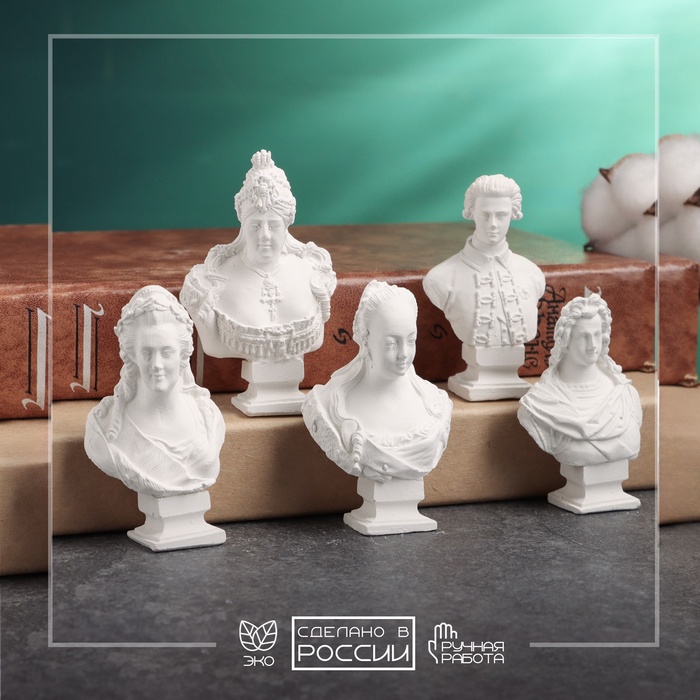
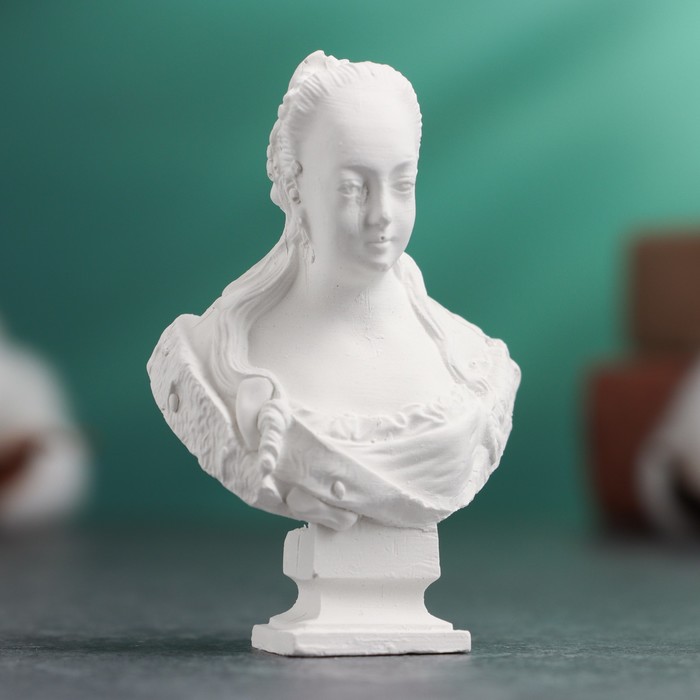
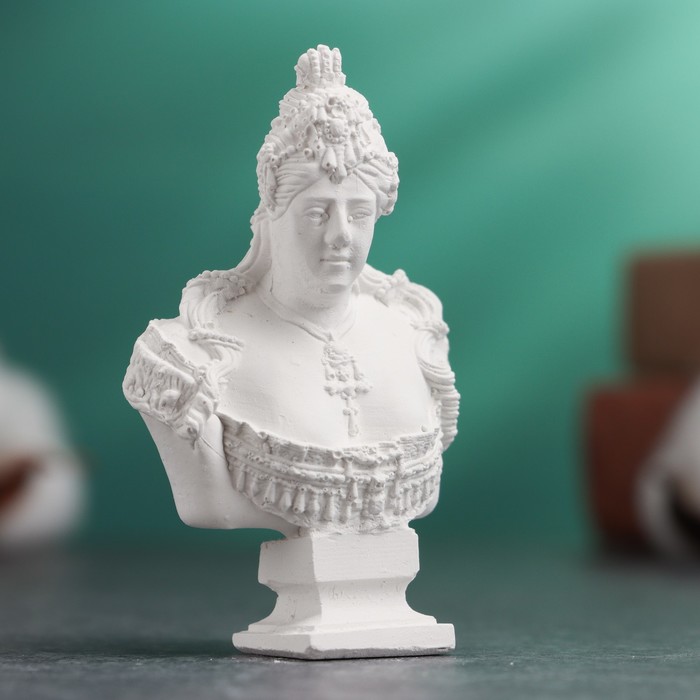
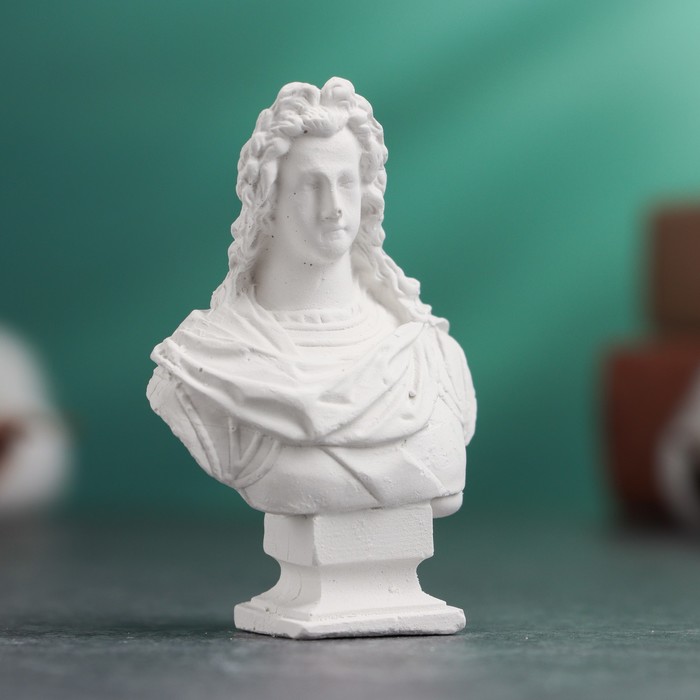


Bust "Empress Elizabeth"
Elizaveta Petrovna 1709 - 1761, Empress and Autocrats All -Russian from the Romanov dynasty 1741 - 1761, the youngest daughter of Peter I and Catherine I.
Elizabeth Petrovna’s reign was noted by the revival of the traditions and ideals of the Petrovsky period, the restoration of the government Senate, the institution of Moscow University, the construction of grandiose palaces and luxury at court, the appearance of the first bank in the Russian Empire. The death penalty was not used. In the Elizabeth era, the Russian Empire successfully fought in the war for the Austrian inheritance, the Russian-Swedish war of 1741-1743 and the Seven Years War. The study and development of Siberia continued.
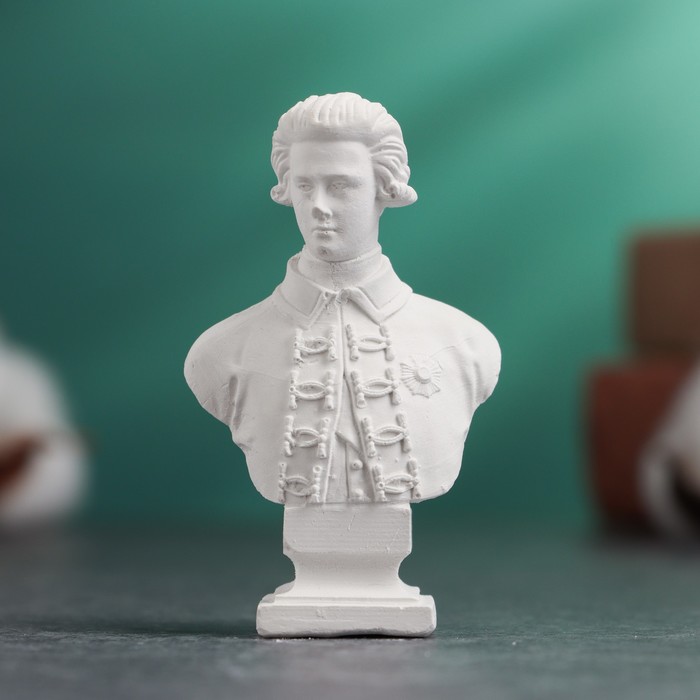
Bust "Emperor Peter III"
Peter III Fedorovich, 1728-1762, the first representative of the Holstein-Gottorp dynasty on the Russian throne.
The All -Russian Emperor since 1762 did not have a clear political program of actions, but he had his own vision of politics, and he, imitating his grandfather Peter I, planned to carry out a number of reforms.
Peter III was abolished by the Secret Chancellery, the process of circulation of church lands into state property was launched, a state bank was created and a decree on freedom of foreign trade was adopted. He also stopped the persecution of the Old Believers. Peter III is also attributed to the intention to reform the Russian Orthodox Church according to the Protestant model. The most important document of the reign of Peter Fedorovich is the “Manifesto of the liberties of the nobility”, thanks to which the nobility has become an exceptional privileged class of the Russian Empire.
Legislative acts adopted during the short rule of Peter III largely became the foundation for the subsequent reign of Catherine II.
Peter III, after a half -year reign, was overthrown as a result of the palace coup, who had the eager to his wife Catherine II on the throne, and soon lost his life in unclear circumstances.
Bust "Empress Anna Ioanovna"
ANNNA IOANNOVNA, 1693 - 1740.
The middle of the three surviving daughters of Tsar Ivan V Alekseevich, niece and godson Peter I, in 1730-1740 - Empress All -Russian from the Romanov dynasty. She was invited in 1730 to the Russian throne by the Supreme Secret Council as a monarch with disabilities (in favor of the aristocrats - “Supers”), subsequently dismissed the Supreme Secret Council and restored the power of the government Senate
played a huge role in the development of the fleet and shipbuilding, established the office of secret search affairs, since she was constantly afraid of conspiracies that threatened her government, so the abuses of this department were huge, thousands of people were exiled or executed.
Patriotic representatives of the Russian Society of the 19th century began to associate all the abuses of power under Anna Ioannovna with the so -called German dominance at the Russian court, calling the Bironovschina.
Bust "Peter II"
Peter II Alekseevich 1715 - 1730. - The Emperor of the All -Russian, who replaced Catherine I on the throne.
The grandson of Peter I, the last representative of the Romanov clan in a straight male line.
Peter II was not able to rule on his own, as a result of which the almost unlimited power was first in the hands of Menshikov, and then Osterman and Dolgoruky.
The first of Peter II’s decrees, long -standing arrears were forgiven by serfs, and freedom was given to the taxes for non -payment of taxes for hard labor.
Under Peter II in Russia, the mitigation of the Code of Punishment began
The so -called “turning tax” was also canceled - to file from each arrived cart.
The last years of Peter II’s reign, some historians are inclined to consider the “boyar kingdom”: much of what appeared under Peter I fell into decay, the old orders began to restore.
The result of the reign of Peter II was the strengthening of the influence of the Supreme Privy Council, which included mostly old boyars
in January 1730. The fourteen -year -old king was infected with smallpox and, having been scorched for about two weeks, died on January 19 (30), 1730.
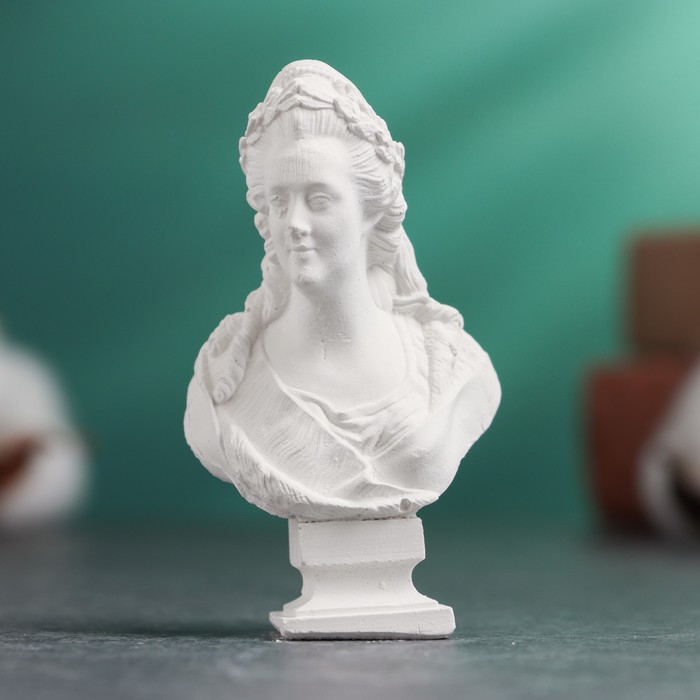
Bust "Empress Catherine II"
Catherine II (Ekaterina Alekseevna); Catherine Velikaya; The nee Sophia Augusta Frederika Angalt-Center (German Sophie auguste Friederike von anhalet-zernburg), in Orthodoxy Ekaterina Alekseevna; April 21 [May 2] 1729, Shtettin, Prussia-November 6, 1796, Winter Palace, St. Petersburg, Russian Empire)-Empress and Autocrats All-Russian (1762-1796). Monarch of enlightened absolutism. The niece of the Swedish king Adolf Friedrich. The cousin of the Prussian king Frederick the Great.
The daughter of the Prince of the Angalt-Terbst, Catherine ascended the throne as a result of the palace coup against her husband-Peter III, who soon died under unclear circumstances (perhaps he was killed). She ascended the throne, following the precedent created by Catherine I, who replaced her deceased husband Peter the Great in 1725.
The Catherine’s era was marked by the maximum enslavement of the peasants and the comprehensive expansion of the privileges of the nobility.
Under Catherine of the Great Border of the Russian Empire, they were significantly extended to the west (sections of the Commonwealth) and to the south (the annexation of Novorossia, Crimea, partly the Caucasus).
Public Administration under Catherine the Second for the first time since the time of Peter I was reformed. Reforms of Catherine II prepared the transformation of the Russian state and society in the first quarter of the 19th century and became a prerequisite for the reforms of the 1860s.
Culturally, Russia finally became one of the great European powers, which the empress herself, who was fascinated by literary activity, collecting masterpieces of painting and consisting with French enlighteners contributed a lot. In general, the policy of Catherine II and its reforms fit into the channel of the enlightened absolutism of the 18th century.
| Characteristics | |
| A country | Russia |
| Coating | Without cover |
| Color | White |
| Height, see | 7 |
| Kind of activity | Political figure |
| Material | Gypsum |
| Personality | Peter III |
There are no reviews for this product.